


Repeat NEET and MBBS abroad can both work, but only for the right student profile.
For Kerala families, repeat neet vs mbbs abroad becomes a serious discussion when a student misses a government MBBS seat. Some students feel they came close enough to try again. Others feel another year of coaching may not change the result and want to begin medical studies outside India.
A repeat year can be useful when there is a real chance of improving marks. Studying MBBS abroad can also be practical when the student is ready for foreign education, long-term planning, and future licensing exams. Neither path is automatically better, and neither should be chosen in a rush.
Panic leads to poor decisions. A better approach is to compare the mark difference, total cost, course structure, university documents, screening exam path, and the student’s ability to stay consistent.
Professional review advised: Confirm current admission, visa, university, NMC, and NBEMS details through official sources before paying any fee.
Why This Decision Is Important for Kerala Students
Kerala students are choosing between two full pathways, not just two admission options.
NEET-UG is the common entrance test for undergraduate medical admission in India, and the National Testing Agency describes it as a common and uniform test for undergraduate medical education. NTA NEET-UG portal For Kerala admissions, the CEE Kerala portal lists professional degree courses including MBBS and BDS, so candidates need to follow official CEE notices for state admission steps. CEE Kerala portal
The choice is bigger than “one more year” versus “foreign college.” It affects the next several years of the student’s life. A repeater spends another year preparing before entering medical college. A student who chooses MBBS abroad may begin earlier, yet later has to meet the required registration route for India.
Local detail: In Kerala, families from Malappuram, Kozhikode, Thrissur, Kollam, Kannur, Palakkad, and Kochi often compare repeat coaching, private MBBS fees, and overseas options at the same time. Relatives, friends, and classmates may all have opinions, which can make the decision feel urgent.
A counselling discussion with helpabroadconsultancy can be useful when the family asks for written proof and checks the key documents before making any payment.
Repeat NEET vs MBBS Abroad, Which Is Better?
Repeat NEET suits near-cutoff students; MBBS abroad suits students ready for verified foreign study and licensing exams.
There is no single winner between repeat NEET and MBBS abroad. The better route depends on the student’s position after NEET.
A repeat year is more suitable when the student missed the likely seat range by a manageable margin, knows which subjects caused the loss, and can follow a strict study routine for one full year. Rising mock-test marks are a good sign. So is emotional readiness. If another attempt will cause severe stress or the student has no plan to change the study method, repeating may not be wise.
MBBS abroad becomes more practical when the mark difference is large, another repeat year feels unrealistic, and the student is serious enough to manage foreign medical education. Independent living, family financial planning, and early preparation for the Indian screening route all matter. Admission alone is not the finish line. Students should also understand how to choose the right destination before applying.
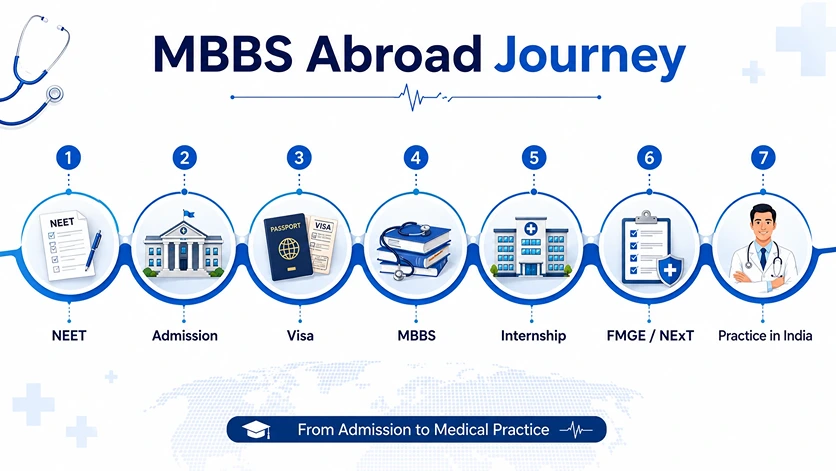
NBEMS identifies FMGE as the Foreign Medical Graduate Examination, also known as the Screening Test for Foreign Medical Graduates, introduced through Screening Test Regulations, 2002. NBEMS FMGE page Anyone considering MBBS abroad must therefore think beyond admission and plan for the return-to-India pathway.
Trade-off: A repeat year delays MBBS but keeps the student within the Indian admission system. Foreign medical study may begin sooner, yet it brings documentation, adjustment, and licensing responsibilities.
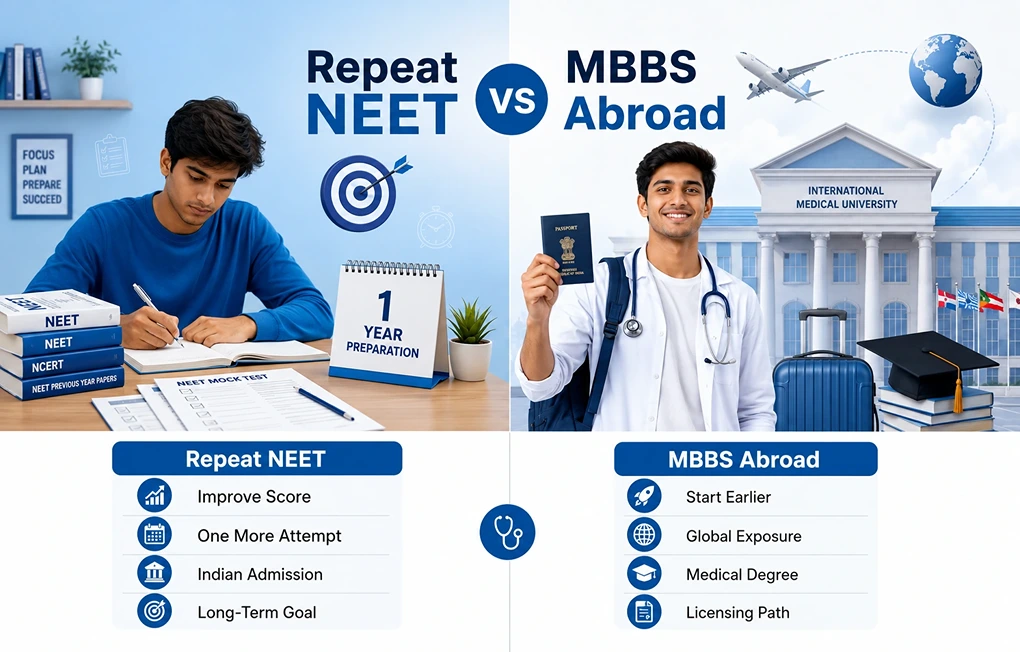
Repeat NEET vs MBBS Abroad — Quick Decision Table
| Factor | Repeat NEET | MBBS Abroad | Better For |
|---|---|---|---|
| Time needed | 1 extra year before MBBS | Can begin in the next eligible intake | Students who want to start sooner may prefer abroad |
| Main purpose | Improve NEET score | Start medical education outside India | Depends on score gap |
| Best student type | Near-cutoff, disciplined, steady | Mature, independent, rule-aware | Case-based |
| Main risk | Score may not improve enough | FMGE/NExT and NMC compliance risk | Repeat NEET has lower foreign-degree risk |
| Cost pattern | Coaching, tests, travel, living for 1 year | Tuition, hostel, food, travel, visa, insurance | Depends on country and family budget |
| Parent role | Support routine and monitor progress | Verify university, fees, visa, and rules | Both need active parent involvement |
| Career route | Indian MBBS route if seat is secured | Foreign MBBS plus Indian licensing path | Depends on long-term goal |
| Best proof before deciding | Mock-test score growth | Written admission, fee, and rule verification | Both need evidence |
Who Should Repeat NEET?
A repeat year is useful only when the student has a clear score-improvement plan.
Repeating NEET is not a failure. For some Kerala students, it is the most sensible next step. The problem begins when the same coaching routine, timetable, test pattern, and mistakes continue for another year without any change in method.
A repeat year makes sense when the target is realistic and the preparation plan can be improved. A student who lost marks due to weak revision, poor Physics problem-solving, careless errors, or exam pressure may improve with tighter practice and better feedback. The previous score should be close enough to make improvement believable, and the student should know why the first attempt did not work.
The decision should not come from shame, comparison, or pressure. One more year is a serious commitment for both the student and the family, so it must be financially and emotionally manageable.
Do this now:
- Step 1: Write the NEET score and target score.
- Step 2: Calculate the score gap honestly.
- Step 3: List the weakest chapters in each subject.
- Step 4: Take three full mock tests within 15 days.
- Step 5: Review whether marks improve without random guessing.
Proof you keep: Mock-test screenshots, chapter error sheet, score tracker, and review dates.
Unpopular truth: A repeat year does not improve marks automatically. The method must change.
Who Should Choose MBBS Abroad?
MBBS abroad works best for students who are serious, independent, and ready to meet official rules.
MBBS abroad may be practical when a student is committed to medicine but unlikely to secure a government MBBS seat in India. It can also enter the discussion when private MBBS in India is beyond the family’s financial comfort.
Still, foreign medical education is not an easy shortcut. The student has to study seriously, adjust to a new country, manage food and culture differences, and prepare for the Indian registration route if the goal is to practise back home. A family may find the route attractive, but the student must be ready for the daily reality of living and studying away from Kerala.
NMC’s Foreign Medical Graduate Licentiate rules include requirements around the medical course, internship, and eligibility to practise in the country where the degree is earned. Its 2021 regulation document mentions a twelve-month internship in the same foreign medical institution, in addition to the course requirement. NMC FMGL regulations NMC has also issued advisories asking Indian applicants to check the structure of foreign medical courses carefully, including the internship requirement at the same foreign university. NMC advisory
This route suits a student whose mark difference is too wide for a practical repeat attempt, whose family has mapped the full course cost, and whose university and course details have been checked in writing. Early preparation for FMGE/NExT should feel realistic, not like something to think about only in the final year.
Trade-off: Overseas MBBS may help the student begin medical education sooner, but it demands stronger planning, self-study, and rule awareness.
Cost, Time, and Career Comparison
Families should compare the full medical journey, not just first-year expenses.
Many parents compare repeat coaching fees with the first-year fee of a foreign university. That comparison is incomplete.
For a repeat year, the visible cost is coaching, but the full picture includes test series, hostel or travel, study material, and one year of time. There is also emotional pressure. If the student does not improve enough, the family may face the same decision again after twelve months.
For MBBS abroad, the first-year fee tells only part of the story. Tuition for the full course, hostel, food, travel, visa, insurance, documentation, currency changes, exam preparation, internship, and registration steps all need to be included in the calculation.
Local detail: In Kerala, many families receive attractive fee sheets for foreign universities. Always ask whether the amount shown is yearly, semester-wise, or full-course. Check what is excluded as well.
Trade-off: Repeating may look cheaper at first, but the outcome is uncertain. Foreign study may look faster, but the full pathway needs careful cost planning.
NMC, FMGE, and NExT Rules Students Must Check
MBBS abroad should be chosen only after checking the future Indian registration path.
For students planning to practise in India after MBBS abroad, admission alone is not enough. A university may offer a seat, but future registration depends on whether the graduate meets the applicable Indian requirements.
The key questions are practical. Is the university recognized in its own country? Is the course duration acceptable under current requirements? Does the internship follow the required format? Can graduates practise in that country after completing the degree? Families also need to look at the medium of instruction, clinical exposure, FMGE/NExT preparation support, and documents required after graduation.
NBEMS lists FMGE under screening tests for foreign medical graduates. NBEMS FMGE page Since rules can change, families should rely on current regulator updates rather than old brochures or social media forwards.
Trade-off: A low-fee university can become costly if course structure, internship, or recognition creates problems later.
Student Situation vs Best Option
| Student Situation | Better Option | Why This Option Fits | What to Check Before Deciding |
|---|---|---|---|
| Missed government seat by a small margin | Repeat NEET | One focused year may improve the score. | Mock-test trend, weak chapters, coaching plan. |
| Score is far below likely government-seat range | MBBS abroad or another health career path | Repeating may not change the result enough. | Full budget, university recognition, NMC rules. |
| Student is motivated but weak in one subject | Repeat NEET | Targeted repair can raise marks. | Subject-wise test scores for 4–6 weeks. |
| Student cannot face another repeat year | MBBS abroad may fit | Starting MBBS may reduce repeat-year pressure. | Emotional readiness and family support. |
| Family cannot verify total foreign-study cost | Do not rush abroad | Partial fee planning can create mid-course stress. | Written fee sheet, refund terms, living costs. |
| Student wants to practise in India after foreign MBBS | MBBS abroad only after rule check | Licensing route is essential. | FMGE/NExT, internship, NMC compliance. |
| Student is not ready to live away from home | Repeat NEET or Indian options | Foreign study needs independence. | Food, climate, hostel, safety, language. |
| Family is comparing private MBBS in India and abroad | Compare the full pathway | First-year fee is not enough. | Total course cost and registration route. |
Common Mistakes and Red Flags
The biggest mistake is choosing quickly without written proof.
Some mistakes appear again and again in medical admission decisions. The most serious ones happen when families act under pressure, trust verbal promises, or compare only the most attractive part of each option.
Watch for these red flags:
- “Pay today or lose the seat” pressure.
- No written fee structure.
- No clear refund terms.
- Vague claims about NMC approval.
- No clarity on internship.
- No graduate contact details.
- No proof of university recognition.
- Claims that licensing exams will be easy.
- Repeat coaching without a changed study plan.
- Choosing only because a friend or neighbour chose it.
Myth vs Fact
Myth | Fact | Date |
Repeating NEET is always a waste. | It can work when the student is close to the target and has a better plan. | 2026-06-27 |
MBBS abroad is an easy route. | It still needs serious study, adjustment, and licensing preparation. | 2026-06-27 |
A lower fee means a better option. | Low cost is useful only when rules, training, and safety are checked. | 2026-06-27 |
A popular consultant means no risk. | Families must still check documents themselves. | 2026-06-27 |
Unpopular truth: A student who is not ready to study hard in India may not suddenly become disciplined abroad.
Case Study and Kerala Field Note
A calm decision becomes easier when the family compares facts instead of emotions.
Field note from Kerala
In many Kerala homes, this decision happens under pressure. One student wants to repeat because classmates are joining coaching. Another wants to go abroad because relatives say it is faster. Parents may feel pulled in different directions because every person seems to have a different answer.
Writing the facts down makes the choice clearer.
Example case
A student from Malappuram has a low NEET score and weak Physics basics. The family has two possible routes.
Choice 1: Repeat NEET
This can work if Physics is repairable, test scores improve, and the student follows a strict plan for one year.
Choice 2: MBBS abroad
This can work if the mark difference is wide, the student is mature, the full cost is manageable, and the university documents match the expected registration path.
Evidence should guide the final call. Rising mock scores may support a repeat year. A very wide gap, combined with readiness for foreign study, may make MBBS abroad more practical.
Local detail: Kerala families often trust word-of-mouth. For medical education, word-of-mouth can support research, but it should not replace documents.
Actionable Checklist and Decision Framework
A written checklist protects families from pressure-based decisions.
A final decision should not depend only on a conversation with a friend, a relative, or a consultant. Use a simple written process so everyone can see the same facts.
Checklist 1: Repeat NEET Readiness
Do this now:
- Step 1: Write your present NEET score.
- Step 2: Write your target score.
- Step 3: Mark your score gap.
- Step 4: List weak chapters in Biology, Chemistry, and Physics.
- Step 5: Take weekly mock tests for one month.
- Step 6: Decide only after reviewing the trend.
Proof you keep: Score sheet, weak-chapter list, mock-test graph, and review date.
Checklist 2: MBBS Abroad Verification
Do this now:
- Step 1: Ask for the university name and country in writing.
- Step 2: Ask for full-course fees, not only first-year fees.
- Step 3: Check course duration and internship details.
- Step 4: Verify recognition in the country of study.
- Step 5: Review current NMC and NBEMS updates.
- Step 6: Speak to current students and graduates.
Proof you keep: Fee letter, admission letter, recognition proof, screenshots from regulator pages, and student feedback notes.
Trade-off: Checklists slow the decision, but they reduce the chance of regret.
FAQs
Repeat NEET is better when the student is close to the expected seat range and has a clear plan to improve. MBBS abroad is better when the gap is large, the student is mature, and the full cost and rules have been checked.
MBBS abroad can lead to practice in India only when the graduate meets applicable requirements and clears the required screening or licensing route. FMGE is the screening test listed by NBEMS for foreign medical graduates. NBEMS FMGE page
A repeat attempt is sensible when the student knows exactly why the previous attempt failed. If the issue was weak revision, poor test practice, or exam anxiety, improvement is possible. Without motivation to change, another year may not help.
It may be cheaper in some cases, but total cost matters more than tuition alone. Include hostel, food, visa, insurance, travel, exam coaching, and currency changes.
The main risk is assuming that admission automatically leads to registration in India. University recognition, course duration, internship, and the screening route all need careful review before joining.
Yes. Early preparation is safer than waiting until the final year. Licensing exams require steady subject understanding, not last-minute memorisation.
The best choice is not the fastest option; it is the option the student can complete successfully.
The decision between repeat NEET vs MBBS abroad should be made with clarity, not fear. A repeat year can be a strong choice for students who are close to the target, ready to work harder, and able to improve through a better study plan.
MBBS abroad can also be a strong choice when the student wants to begin medical education sooner, can live independently, and has a family prepared to check the full cost, university details, and future licensing path.
For Kerala students, the decision should be written down clearly. What is the mark difference? What is the total cost? Which risks are manageable? Which documents support the plan? What happens after graduation?
A good decision is not the one that sounds impressive. It is the one the student and family can follow responsibly from admission to registration.
Need Help Making the Right Decision?
Compare Repeat NEET and MBBS Abroad with expert guidance based on your NEET score, budget, and career goals—before making any admission decision.
Book Your Free Counselling