

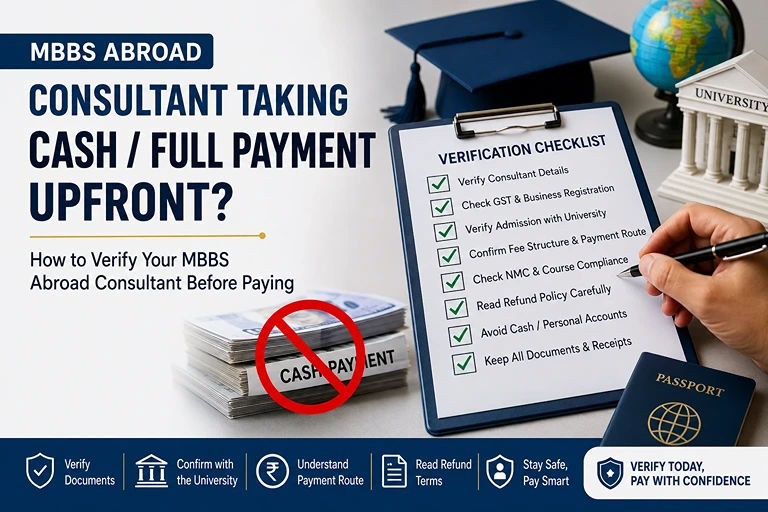
Families should verify the consultant, university and course before paying the complete MBBS admission amount.
To verify an MBBS abroad consultant, begin with documents rather than promises.
A consultant asking for full payment upfront, particularly in cash, may make students and parents uncomfortable. That concern is reasonable. A large advance payment reduces the family’s control if the admission, visa, accommodation or refund process does not go as expected.
However, an advance-payment request does not automatically mean that the consultant is fraudulent. Some universities have fixed payment deadlines, and some admission processes involve advance charges. The important issue is whether the request is clear, documented and independently confirmed.
HelpAbroadConsultancy advises families to treat payment verification as part of the admission process, not as a question to consider after the money has already been transferred.
Why Full Upfront Payment Can Be Risky
Paying everything early increases the family’s financial exposure before the consultant has completed the promised work.
An MBBS admission package may include tuition, hostel fees, insurance, visa support, documentation and consultancy charges. When all these costs are combined into one amount, parents may not know who receives each part of the payment.
For example, a parent may believe that the entire amount is refundable university tuition. The consultant may consider a portion of it a non-refundable service charge. The university may not have received any payment at that stage.
Cash makes this situation more difficult because there may be no independent banking record. A receipt helps, but only when it clearly states the legal business name, amount, purpose, date, student’s name and refund conditions.
The safest approach is to understand every part of the payment before handing over money. Convenience should not come at the cost of clarity.

How to Verify the Consultant Before Paying
A genuine consultant should be willing to provide records that can be checked without relying on the consultant’s own claims.
Start by asking for the consultant’s exact legal business name. This name should match the agreement, invoice, receipt and business bank account.
Where the consultant provides a GST number, families can search it through the official GST system. The search can display details such as the legal name, trade name, registration status and principal place of business. These details help confirm the business identity, although they do not prove that the consultant’s admission advice is correct.
A business may operate under a brand name that differs from its registered name. This is not automatically suspicious. The consultant should, however, explain the relationship clearly and issue all financial documents under the correct legal entity.
The office should also be verified. Check whether the address on the agreement matches the registration and invoice. Meet the person who is authorised to sign the agreement rather than depending only on a counsellor or freelance representative.
A well-designed office, active social media account or large number of followers should not be treated as proof. These signs may show that a consultancy is established, but they cannot confirm the safety of a specific payment or university.
Verify the Admission Directly With the University
An admission letter should be confirmed through contact details found independently on the university’s official website.
A consultant may send an admission letter through WhatsApp or email, but the student should not stop there.
Visit the university’s official website and find the admissions office or international student department. Send them the admission letter and ask them to confirm the student’s name, programme, campus, intake, fee and application number.
The university should also confirm where tuition must be paid. Do not transfer money using bank details printed only on a consultant’s invoice. Compare them with the university’s official payment instructions.
This direct check is important because admission authenticity and consultant reliability are two different questions. A consultant may be a registered business while an admission document contains an error. Similarly, an admission letter may be genuine while the payment demand contains charges that the university does not require.
The family should also request the university’s complete fee structure and refund policy. Statements such as “all charges are included” or “refund as per university rules” are too vague unless those rules are provided in writing.
Check Whether the Course Meets Current NMC Requirements
Students must check the exact foreign medical programme instead of relying on claims that a university is generally “NMC approved.
One of the most common statements in overseas medical admissions is that a university is “NMC approved.” Parents should treat this phrase carefully.
The National Medical Commission states that it does not endorse a general list of foreign medical institutions that students can treat as an approved-college list. Students are responsible for examining the university and programme before taking admission.
This means the family should not ask only whether the university is recognised. They should examine whether the exact course, campus, clinical arrangement and internship structure meet the requirements applicable to the student.
The Foreign Medical Graduate Licentiate Regulations address several areas of foreign medical education, including course duration, internship, teaching medium, required subjects, clinical training and eligibility to practise in the country where the qualification is awarded.
The latest applicable NMC rules and advisories should be checked before admission because requirements may change.
| Course Check | What the Family Should Confirm | Review Stage |
|---|---|---|
| Course duration | Full academic period matches current rules | Before admission |
| Internship | Required internship structure is included | Before admission |
| Teaching medium | Classes and examinations meet current conditions | Before admission |
| Clinical training | Real hospital exposure is available | Before enrolment |
| Local eligibility | Graduate can meet local practice conditions | Before payment |
| Campus details | Exact campus is authorised for the programme | Before admission |
A genuine admission letter does not automatically prove that the course will meet future registration requirements in India.
Professional review advised before making a final decision about a foreign medical programme.
Decide Who Should Receive the Money
University tuition and consultant service charges should be identified separately, even when offered as one admission package.
Where possible, tuition should be paid directly to the university’s official bank account. The consultant’s service fee can then be paid separately to the consultancy’s verified business account.
This arrangement creates a clearer record. It shows which amount reached the university and which amount was paid for admission assistance.
There may be situations where a university authorises a representative to collect fees. In that case, ask the university to confirm the arrangement directly. The confirmation should identify the representative and the amount they are permitted to collect.
Avoid transferring money to an employee’s personal account unless there is a written and independently verified reason. A verbal explanation such as “our company account is temporarily unavailable” is not enough for a high-value payment.
| Payment Route | Evidence Level | Main Concern | Review Date |
|---|---|---|---|
| Cash without a receipt | Very low | Difficult to prove payment | Before payment |
| Cash with a full receipt | Medium | Receipt may be the only record | Before payment |
| Personal bank account | Medium | Recipient may not match agreement | Before payment |
| Consultant’s business account | High | Invoice must explain the service | Before payment |
| University’s official account | High | Confirm bank details independently | Before payment |
A consultant who objects to reasonable payment questions should be treated with caution. A genuine payment arrangement should be explainable in simple language.
Read the Refund Terms Carefully
A refund promise is useful only when it explains who will return the money, under what conditions and after which deductions.
Refund disputes often begin because families focus only on whether a payment is “refundable.” That word alone is not enough.
The agreement should explain what happens if the visa is refused, the student withdraws, the university rejects the application or the course is cancelled. It should also explain whether registration fees, consultancy charges, hostel deposits, currency losses and bank charges will be deducted.
For instance, a consultant may promise a “full university refund” while keeping the consultancy fee. The statement may technically be correct, but the parent may understand it as a refund of the entire amount paid.
The refund policy should therefore use actual amounts or clear categories. It should also identify who processes the refund and where it will be sent.
Before paying: Read the agreement, confirm the fee division, verify the university’s refund rules and save a signed copy.
After paying: Obtain the receipt, confirm that the intended recipient received the money and request written confirmation of the next admission step.
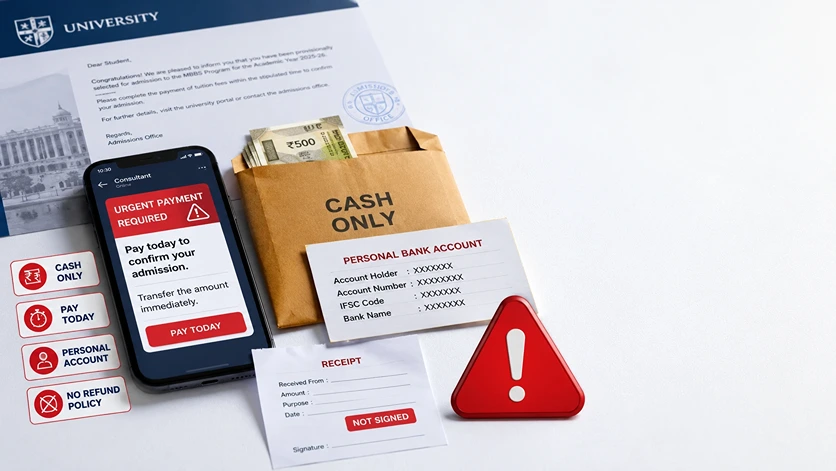
Warning Signs That Should Stop the Payment
Pressure becomes dangerous when it is combined with missing documents, personal accounts or unverifiable promises.
A short university deadline may be genuine. Urgency alone does not prove wrongdoing. The concern becomes serious when the deadline is used to prevent the family from checking documents.
Cash-only demands without a receipt are a major warning sign. So are guarantees of a visa, admission or future licensing-examination result. These decisions are not fully controlled by the consultant.
Other serious concerns include refusal to provide the agreement before payment, reluctance to allow university contact, unclear refund conditions, changing bank accounts and different company names appearing across documents.
Families should also be cautious when a consultant asks them to hide information from the university, embassy, bank or parents. A legitimate admission process should not depend on false statements.
Myth vs Fact
Myth | Fact |
A GST number proves the admission is safe | It helps verify the business, not the course or payment |
A genuine letter proves NMC compliance | Admission and regulatory compliance are separate |
Cash is safe when the consultant is popular | Popularity does not replace payment evidence |
A consultant can guarantee a visa | Visa decisions belong to the relevant authority |
An expensive consultant must be reliable | Price does not guarantee correct advice |
The unpopular truth is that families sometimes ignore warning signs because they are afraid of losing a seat. A genuine consultant should allow reasonable verification, even when a deadline exists.
A Practical Family Example
Verification can improve a payment arrangement without accusing the consultant of fraud.
Consider a family from Kerala whose child receives an overseas medical admission offer. The consultant asks for the entire first-year amount within two days and says cash will make the process faster.
Instead of immediately accepting or rejecting the request, the family asks for the official university fee structure. They also email the university using the address listed on its website.
The university confirms that the admission letter is genuine. However, it states that tuition should be paid directly to the university and that hostel fees are payable only after room allocation.
The consultant then explains that the original amount combined several costs for convenience. The family agrees to pay tuition directly to the university. The consultancy fee is divided into stages based on application, visa and departure support.
No accusation was necessary. The verification simply changed an unclear transaction into a documented one.
This is the central lesson: verification protects both the family and an honest consultant because everyone understands the payment terms.
Frequently Asked Questions
Parents should treat consultant identity, admission validity and course compliance as separate checks.
No. Some legitimate processes require advance fees. The family should still confirm the payment purpose, recipient, refund conditions and university instructions before paying.
Cash provides less independent evidence than a bank transfer. When cash is unavoidable, obtain a signed and numbered receipt showing the legal business name, amount, purpose, student’s name and remaining balance.
Only after the university independently confirms that the consultant is authorised to collect it. Otherwise, paying tuition directly to the university usually creates a clearer record.
Contact the university through details found on its official website. Ask the admissions office to confirm the student, programme, campus, fees and payment account.
The NMC does not provide a general endorsed list that students should treat as proof of course compliance. The exact programme must be checked against the rules applicable to the student.
Collect the agreement, receipt, bank record, messages and admission documents. Ask the consultant in writing to explain how the money was used. For overseas consular grievances, the Ministry of External Affairs provides the MADAD system for registration, tracking and escalation of certain complaints.
The safest MBBS abroad payment is one supported by independent university confirmation, clear documents and a traceable payment record.
Choosing an MBBS programme abroad involves more than finding a university and securing an admission letter. Students and parents must also understand the consultant’s role, the course requirements, the fee structure and the refund conditions.
A request for full advance payment does not automatically mean that a consultant is fraudulent. However, no family should make a large payment only because a counsellor creates urgency or promises that the seat may be lost.
Before paying, confirm the consultant’s legal identity, verify the admission directly with the university and check where each part of the payment will go. University tuition, accommodation costs and consultancy charges should be clearly separated. Every important promise should appear in writing.
Families should also review the latest NMC requirements for the exact programme, campus and admission year. A genuine admission letter does not by itself confirm that the course will meet future registration requirements in India.
The final decision should be based on evidence, not pressure. A careful verification process may take additional time, but it can protect the student’s education, the family’s money and their ability to respond if something goes wrong.
Verify Before You Pay
Review your MBBS abroad admission, fees, and payment details with our experts before making any payment.
Get Free Guidance