

MBBS abroad is safe only when university, licensing path, fees, and exam risks are verified with official proof
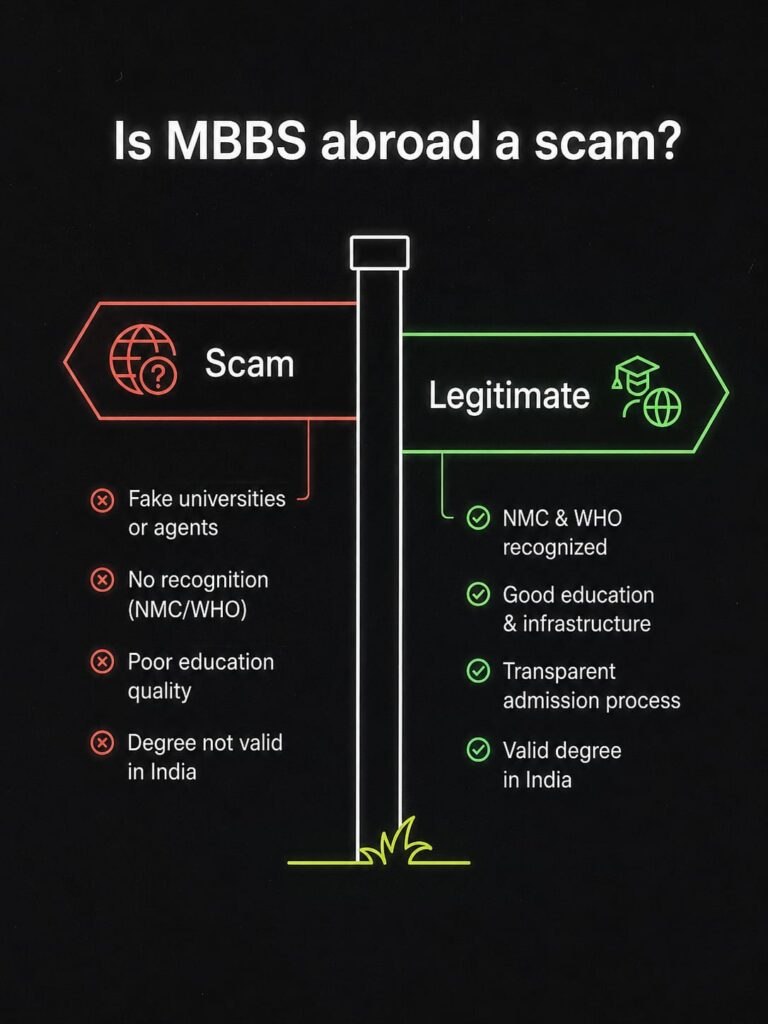
Is MBBS abroad a scam? This is one of the most common questions Indian students and parents ask before choosing a foreign medical university.
Many students choose MBBS abroad because getting a medical seat in India is difficult and private medical college fees can be high. This pressure makes families depend on agents, brochures, YouTube videos, WhatsApp messages, and family referrals.
Some counsellors are genuine. Some universities are genuine. But some offers are built on half-truths like “NMC approved,” “WHO approved,” “guaranteed FMGE pass,” “no risk,” or “last seat today.”
A safe MBBS abroad decision should not be based on fear, pressure, or discounts. It should be based on proof.
Is MBBS Abroad Really a Scam?
MBBS abroad is not a scam by default; fake claims around it create the real risk.
No, MBBS abroad itself is not a scam. Many Indian students study medicine outside India. The problem starts when the admission process hides important details about university status, course structure, clinical training, internship, FMGE, total cost, or refund terms.
A genuine MBBS abroad option should clearly answer these questions:
- Is the university legally recognized in its own country?
- Is the medical course taught in English?
- Is clinical training properly included?
- Is the internship path clear?
- Can the student return to India and follow the required registration process?
- Can fees be paid directly to the university?
- Are all promises written in the agreement?
If these answers are unclear, parents should stop and verify before paying.
Unpopular truth: MBBS abroad is not dangerous because it is abroad. It becomes dangerous when families choose without verification.
What Does “NMC Approved” Really Mean?
“NMC-approved foreign university” is often a misleading phrase unless explained with official rules
Many parents ask, “Is this foreign university NMC approved?” This is a common question, but it can create confusion.
The National Medical Commission says it does not endorse any list of foreign medical institutions or universities for MBBS or equivalent courses. So, if an agent says “NMC approved university,” parents should ask for the exact official rule behind that claim.
A safer question is:
“Does this university and course meet the current requirements for foreign medical graduates who want to practice in India?”
Even then, parents should not depend only on the agent’s answer. They should verify through official sources.
Parent warning: A confident agent is not the same as a verified university.
Is WHO or WDOMS Listing Enough?
WDOMS listing confirms a medical school exists; it is not automatic approval for Indian
Some agents say, “This university is WHO approved.” Parents should be careful with this phrase.
The World Directory of Medical Schools says listing a medical school does not mean recognition, accreditation, or endorsement by the directory or its partner organizations unless clearly stated. WFME also explains that a World Directory listing confirms that the medical school exists, but it does not automatically mean recognition, accreditation, or endorsement.
This means WDOMS listing is useful, but it is not the final proof.
Parents should still check:
- University recognition in that country
- Course duration
- Medium of instruction
- Clinical training
- Internship
- FMGE preparation support
- Indian registration pathway
Trade-off: Directory checks are easy, but Indian registration depends on rules, training, documents, and exam performance.
FMGE Is the Real Filter
FMGE risk should be discussed before admission, not after graduation
For many Indian students who study medicine abroad, FMGE is a major step before medical registration in India.
The FMGE June 2026 information bulletin says a candidate is declared pass only if they score at least 150 marks out of 300. The result is declared as pass or fail. It also says there is no provision for re-evaluation, rechecking, re-totaling, or grace marks.
This means getting admission abroad is only the first step. The bigger test comes later.
Before choosing a university, parents should ask:
- Does the university support Indian students preparing for FMGE?
- Are clinical subjects taught properly?
- Do students get enough hospital exposure?
- Are Indian exam-style tests conducted?
- Are previous FMGE results available?
- Do graduates return to India smoothly?
Unpopular truth: A student who is not ready for hard self-study may struggle abroad, even if admission is easy.
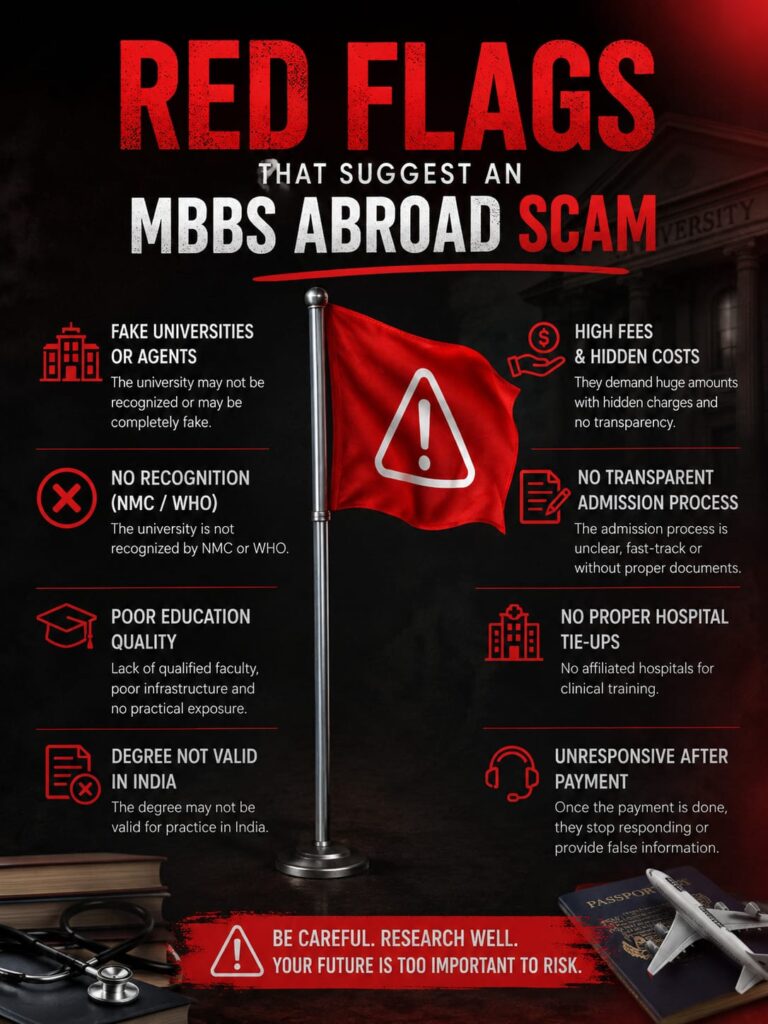
Red Flags That Suggest an MBBS Abroad Scam
The fastest way to spot risk is to ask for written proof before payment
Parents should be careful if an agent says:
- “Pay today, last seat.”
- “No need to worry about NMC.”
- “This is 100% NMC approved.”
- “FMGE pass is guaranteed.”
- “WHO approved means everything is safe.”
- “No need to contact the university directly.”
- “Fees must be paid to our personal account.”
- “Documents will come after advance payment.”
- “Everyone from Kerala is going there.”
- “No need to check hospital training.”
A real admission process should not fear verification. If the agent avoids written proof, direct university contact, or official sources, parents should treat it as a warning sign.
Trade-off: Agents can save time, but direct checking with official university email and current official notices reduces risk.
Cheap Package vs Real Expense
The cheapest MBBS abroad package is not always the safest or lowest-cost choice.
| Cost item | Question to ask | Unit | Date checked |
|---|---|---|---|
| Tuition | Paid yearly or semester-wise? | INR/year | 2026-07-08 |
| Hostel | Compulsory or optional? | INR/month | 2026-07-08 |
| Food | Indian food or self-cooking? | INR/month | 2026-07-08 |
| Travel | How many India trips per year? | INR/trip | 2026-07-08 |
| Visa and insurance | Included or separate? | INR/year | 2026-07-08 |
| FMGE preparation | Included or separate? | INR/course | 2026-07-08 |
Clinical Training and Internship Must Be Clear
Course structure, clinical training, internship, and medium of instruction should be checked before admission.
Parents should not check only the university name. They should check how the course is actually delivered.
Before paying, ask the university these questions:
- Where will clinical training happen?
- Will students get patient exposure?
- Is the full course taught in English?
- Is internship included?
- Is internship done in the same country?
- Is the hospital attached to the university?
- Will the student get documents needed for future registration?
Trade-off: A university may offer easy admission, but weak clinical exposure can hurt the student later.
Field Note From Parent Counselling
A five-question email test can expose weak MBBS abroad offers before payment.
During a parent counselling review in Kerala, one pattern appeared again and again. Families asked about hostel rooms, Indian food, climate, and travel. But they did not always ask enough about clinical training, internship, medium of instruction, and Indian registration.
A simple test helped.
The parent sent the same five questions to the agent and the university’s official admission email:
- What is the exact degree name?
- Is the full course taught in English?
- Where is clinical training done?
- Is internship included?
- Can fees be paid directly to the university?
When the answers did not match, the family paused the payment.
That pause was important. It gave them time to check documents, speak to current students, and avoid a rushed decision.
Field note: A delay of two days before payment can save a family from years of stress.
Checklist Before Paying for MBBS Abroad
Parents should verify the offer, payment route, and registration path before paying any
| Step | Action |
|---|---|
| Step 1 | Save the university’s official website. |
| Step 2 | Get the official admission email. |
| Step 3 | Ask for the full fee sheet for all years. |
| Step 4 | Ask whether fees can be paid directly to the university. |
| Step 5 | Check NMC guidance for students studying abroad. |
| Step 6 | Check the latest NBEMS FMGE bulletin. |
| Step 7 | Verify WDOMS listing, but do not treat it as approval. |
| Step 8 | Ask for written proof of English-medium teaching. |
| Step 9 | Ask where clinical training and internship happen. |
| Step 10 | Speak to current students and recent graduates. |
| Proof you keep | University email, fee sheet, payment receipt, official notices, student call notes, screenshots, and verification date. |
Common Mistakes Parents Make
Most MBBS abroad mistakes happen because families rush under pressure.
The first mistake is trusting one brochure. A brochure is marketing material, not proof.
The second mistake is trusting old information. NMC, NBEMS, visa, and university rules can change. Parents should check current official notices before paying.
The third mistake is copying another student’s path. One student’s success does not prove that the same university is safe for everyone.
The fourth mistake is ignoring the student’s discipline. MBBS abroad still needs serious study, strong basics, language adjustment, clinical exposure, and exam planning.
The fifth mistake is focusing only on admission. Families should think about the full path: admission, study, clinical training, graduation, screening exam, internship, and registration.
Local detail: In many Kerala families, relatives may suggest a country or university because “someone we know went there.” That is helpful as a starting point, but it is not enough for a final decision.
FAQs About MBBS Abroad Scams
Parents should get direct answers before they pay, not after admission
No. MBBS abroad is not automatically a scam. But fake agents, unclear universities, hidden costs, weak clinical training, and false approval claims can make it risky.
It can be valid if the student meets Indian rules, qualifies the required screening process, completes required training, and gets registration. Parents should verify the latest official rules before admission.
NMC says it does not endorse any list of foreign medical institutions or universities for MBBS or equivalent courses. So parents should be careful with the phrase “NMC-approved foreign university.”
No. WDOMS listing does not mean recognition, accreditation, or endorsement unless clearly stated. It is one check, not the final decision.
For many Indian students with foreign medical qualifications who want registration in India, FMGE is an important screening route. The latest NBEMS bulletin should be checked before admission.
No agent can honestly guarantee FMGE pass. FMGE depends on the student’s preparation, medical knowledge, clinical understanding, and exam performance.
MBBS abroad is not the problem; choosing without verification is the problem.
MBBS abroad is not a scam by default. It can be a real option for Indian students who are ready for hard study, careful planning, and the licensing process after graduation.
But it becomes risky when families trust phrases like “NMC approved,” “WHO approved,” “guaranteed FMGE pass,” or “last seat today” without checking official documents.
The safest approach is to verify everything before paying: university status, fee structure, medium of instruction, clinical training, internship, refund policy, FMGE support, and Indian registration route.
Parents should also speak to current students and recent graduates. They should keep written proof of every promise.
A good MBBS abroad consultant will not rush the family. They will explain the risks, share documents, and allow direct verification.
The final rule is simple: MBBS abroad is not the problem. Choosing without verification is the problem.
Professional review advised before final admission, payment, visa, or registration decisions.