


Medical career opportunities abroad are growing rapidly due to a global shortage of healthcare professionals. Countries like the USA, UK, Canada, Australia, and Germany are constantly recruiting skilled doctors, nurses, and allied health workers. This demand is driven by increasing patient loads, aging populations, and expansion of healthcare infrastructure.
For Indian professionals, especially from states like Kerala, this represents a strong career path. Many students begin exploring foreign opportunities early because of limited super-specialty seats and intense competition in local healthcare systems. However, this path requires careful preparation, including exams, language training, and documentation.
International healthcare systems depend heavily on foreign-trained professionals to maintain workforce balance.
Growing Demand for Medical Professionals
The global demand for healthcare workers is increasing due to multiple interconnected factors. Aging populations in developed countries require continuous medical attention, long-term care, and specialized treatment. At the same time, chronic diseases such as diabetes, cardiovascular conditions, and cancer are increasing at a global scale.
Healthcare systems in many countries are struggling to fill vacancies with local professionals alone. This creates strong opportunities for international recruitment. In countries like India, many professionals choose migration because of limited specialization opportunities and slower career progression in government healthcare systems.
Global healthcare shortages are one of the most consistent drivers of international medical recruitment.
Who Can Apply for Medical Careers Abroad
Medical career opportunities abroad are open to a wide range of healthcare professionals. Doctors with MBBS or higher qualifications can apply after clearing licensing requirements. Nurses are in extremely high demand, especially in ICU, emergency care, surgical units, and elderly care facilities. Allied health professionals such as radiologists, lab technicians, physiotherapists, and pharmacists also have strong global demand.
Nursing and allied health roles often have slightly faster migration pathways compared to doctors because their licensing systems are more streamlined in some countries. This makes them a preferred option for faster relocation.
Nursing remains one of the fastest-growing international healthcare migration categories.
Eligibility Requirements
To work abroad, candidates must meet strict eligibility requirements designed to ensure patient safety and professional standards. The first requirement is a recognized medical qualification such as MBBS, BSc Nursing, or allied health degrees from an accredited institution. Without proper recognition, applications are usually rejected.
The second requirement is licensing exams. Each country has its own system designed to test medical knowledge and clinical reasoning. For example, the USA uses USMLE, the UK uses PLAB, Canada uses MCCQE, Australia uses AMC exams, and Germany requires Approbation along with medical evaluation processes.
Language proficiency is another critical requirement. English-speaking countries require IELTS or TOEFL, while Germany requires German language certification. This is essential because communication is a core part of medical practice, including patient interaction, documentation, and teamwork.
Most countries also prefer candidates with clinical experience or completed internships. This ensures that professionals are capable of handling real-life patient situations rather than only theoretical knowledge.
Communication skills are equally important as clinical knowledge in international healthcare systems.
Table 1: Country-Wise Medical Licensing System
Country | Exam System | Language Requirement | Extra Requirement | Year |
USA | USMLE Steps 1–3 | IELTS/TOEFL | Residency match | 2026 |
UK | PLAB 1 & 2 | IELTS/OET | GMC registration | 2026 |
Canada | MCCQE + NAC | IELTS | Provincial licensing | 2026 |
Australia | AMC exams | IELTS/OET | Clinical assessment | 2026 |
Germany | Approbation | German B1–C1 | Medical adaptation year | 2026 |
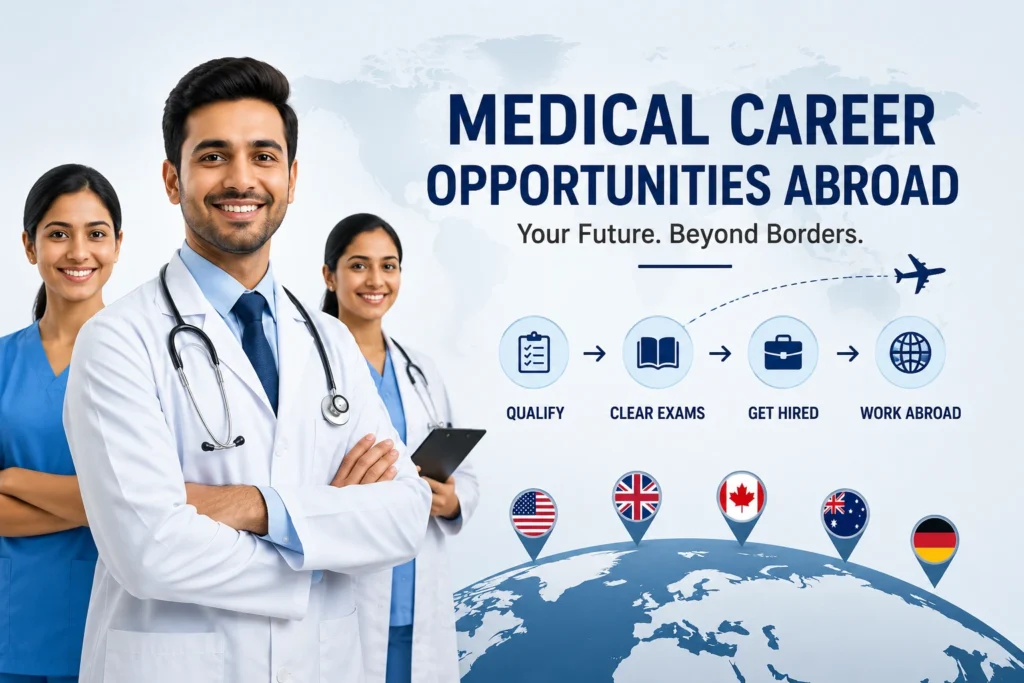
Step-by-Step Process to Work Abroad
The process begins with selecting a country based on career goals, salary expectations, and difficulty level. After selecting a destination, candidates must verify whether their medical degree is recognized by that country’s medical council.
The next stage involves intensive preparation for licensing exams, which can take several months or even years depending on the candidate’s study plan. After passing exams, language certification becomes mandatory for communication and hospital integration.
Once all academic requirements are completed, candidates apply for jobs, residency programs, or hospital placements. Finally, visa processing and relocation steps are completed before starting work in the destination country.
Top Countries for Medical Careers Abroad
The USA is known for offering the highest salaries but has the most difficult licensing process, requiring multiple exams and residency matching. The UK offers a structured NHS system with clear career progression and relatively simpler licensing compared to the USA. Canada provides a balanced work-life environment with strong healthcare demand but competitive licensing pathways. Australia offers good salaries and regional job opportunities. Germany is highly attractive due to strong demand but requires fluency in German for professional practice.
Choice of country significantly impacts both salary potential and migration difficulty.
Table 2: Salary & Work Comparison
Country | Doctors Salary | Nurses Salary | Work Style | Year |
USA | $8K–$15K | $4K–$7K | High pressure, high pay | 2026 |
UK | £4K–£8K | £2K–£4K | Structured NHS system | 2026 |
Canada | CAD 6K–12K | CAD 3.5K–6K | Balanced workload | 2026 |
Germany | €5K–€10K | €2.5K–€4.5K | Language-based system | 2026 |
Benefits of Working Abroad
Working abroad in the medical field provides several long-term benefits that go beyond just higher salaries. One of the biggest advantages is access to advanced healthcare systems where professionals can work with modern medical technology, updated treatment methods, and internationally standardized protocols. This helps improve clinical knowledge and professional skills significantly.
Another major benefit is international exposure, which allows healthcare workers to learn different medical practices and interact with professionals from diverse backgrounds. Many countries also offer better work-life balance compared to high-pressure environments in developing nations, allowing doctors and nurses to manage their personal and professional lives more effectively.
International medical experience improves long-term career growth and global job opportunities.
Challenges in Medical Careers Abroad
Despite the advantages, medical careers abroad come with several challenges that candidates must be prepared for. One of the biggest challenges is the long and complex process of licensing exams, which can take months or even years depending on the country. Each country has its own strict requirements, making the process time-consuming.
Another major challenge is the financial cost involved. Exam fees, coaching classes, study materials, language tests, and relocation expenses can become expensive for many candidates. Along with this, adapting to a new culture, healthcare system, and patient communication style can also be difficult in the initial stage.
Financial planning and exam preparation are the biggest barriers in international medical migration.
Common Mistakes
Many candidates make mistakes that delay or negatively affect their medical career abroad journey. One common mistake is choosing a country without properly researching its licensing system, job demand, or difficulty level. This often leads to wasted time and repeated preparation in the wrong direction.
Another major mistake is delaying exam preparation and language training. Since exams like USMLE, PLAB, or AMC require long preparation time, starting late can significantly slow down the entire migration process. Some candidates also depend too much on agents or consultants without verifying official guidelines.
Poor planning at the early stage is the main reason for failure in medical career migration.
Kerala Perspective
In Kerala, medical career opportunities abroad are very popular among students and healthcare professionals. Many graduates start planning early due to limited super-specialty seats and strong awareness of international job opportunities. Countries like the UK and Germany are often preferred because of structured career pathways and stable healthcare systems.
A large number of candidates begin preparation during internship or final-year studies. This early start helps them understand licensing exams and language requirements better. It also reduces the total time needed to reach abroad and start working.
Early preparation during internship significantly increases success rate in foreign medical careers.
Step-by-Step Action Plan
The process of building a medical career abroad starts with selecting the right country based on salary expectations, exam difficulty, and long-term career goals. This decision is very important because each country has different rules, and changing plans later can delay progress.
After selecting a country, candidates must check degree recognition and start preparing for licensing exams like USMLE, PLAB, AMC, or others. At the same time, language training such as IELTS or German certification should begin early to avoid delays later in the process.
Parallel preparation of exams and language reduces migration time significantly.
FAQs
Yes, working abroad is not easy because it involves licensing exams, language requirements, and strict eligibility checks. However, with proper preparation and planning, it is achievable for dedicated candidates. The difficulty depends on the country you choose and how early you start preparing.
There is no single “best” country because it depends on your goals. The USA offers the highest salaries but has very difficult exams. The UK provides a structured NHS system. Canada offers balanced work-life conditions, while Germany has strong demand but requires German language skills.
Yes, nurses and allied health professionals often have faster migration pathways compared to doctors. Many countries actively recruit nurses due to high demand, especially in ICU, emergency, and elderly care departments.
On average, it takes around 2 to 4 years depending on the country, exam preparation time, and language requirements. Some candidates may complete the process faster, while others may take longer based on preparation speed and exam attempts.
Yes, for most English-speaking countries such as the USA, UK, Canada, and Australia, IELTS or TOEFL is mandatory. It ensures that healthcare professionals can communicate effectively with patients and hospital staff.
The biggest challenge is the long preparation process, including licensing exams, language tests, and documentation. Many candidates also struggle with cultural adaptation and financial planning during the transition period.
Success in international medical careers depends more on preparation strategy than opportunity availability.
Medical career opportunities abroad offer strong long-term benefits, including higher salaries, advanced medical exposure, and international recognition. These opportunities help healthcare professionals build a more global and stable career path.
However, success in this journey depends on proper planning, consistent preparation, and understanding country-specific requirements. Many candidates fail not due to lack of ability, but due to lack of structured preparation.
Ultimately, medical migration is a long-term process that rewards those who are disciplined, patient, and well-prepared.
Success in international medical careers depends more on preparation strategy than opportunity availability.
Start Your Medical Career Abroad with Expert Guidance
Planning to work abroad as a doctor, nurse, or healthcare professional? Get complete support for country selection, licensing exam guidance, admissions, documentation, and visa assistance to begin your international medical career confidently.
Get Free Consultation