

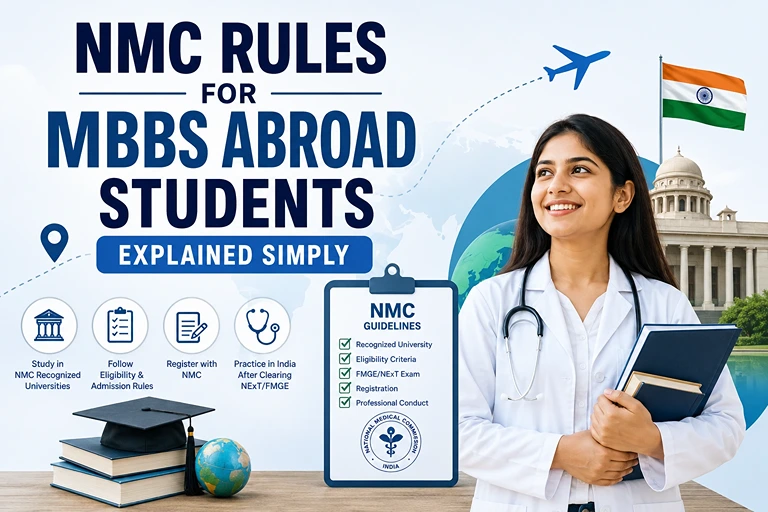
Parents should check NMC rules before admission, not after graduation.
Will my child be able to practise in India after completing MBBS abroad? This is one of the most important questions Indian parents should ask before choosing a foreign medical university. A foreign mbbs valid in india depends on whether the student follows the required NMC pathway from the beginning. A medical degree alone does not automatically guarantee the right to practise in India. Students must understand key requirements such as NEET qualification, course duration, internship, registration eligibility in the country of study, and the licensing examination required in India. Checking these points before admission helps families make informed decisions and avoid confusion later. This article explains the main rules in simple language so students and parents can plan MBBS abroad with better clarity.
Why NMC Rules Matter Before MBBS Abroad Admission
One missing rule can create registration difficulty even after completing the degree.
The National Medical Commission, or NMC, regulates medical education standards and medical registration in India. For Indian students studying medicine abroad, NMC rules matter because they decide whether the foreign medical qualification can be used for the Indian registration pathway.
Many families compare universities by fee, hostel, food, weather, travel distance, and safety. These are important points, but they are not enough. Parents should also check whether the course structure, internship, language of teaching, and registration rights match Indian requirements.
NMC has clarified that it does not endorse any list of foreign medical institutions or universities for MBBS or equivalent courses. That means parents should be careful with claims like “NMC approved university” and should instead verify the exact course pathway.
Local field note: In many Kerala admission discussions, parents first ask, “Which country is cheaper?” A safer first question is, “Will this exact course keep my child eligible for registration in India?”
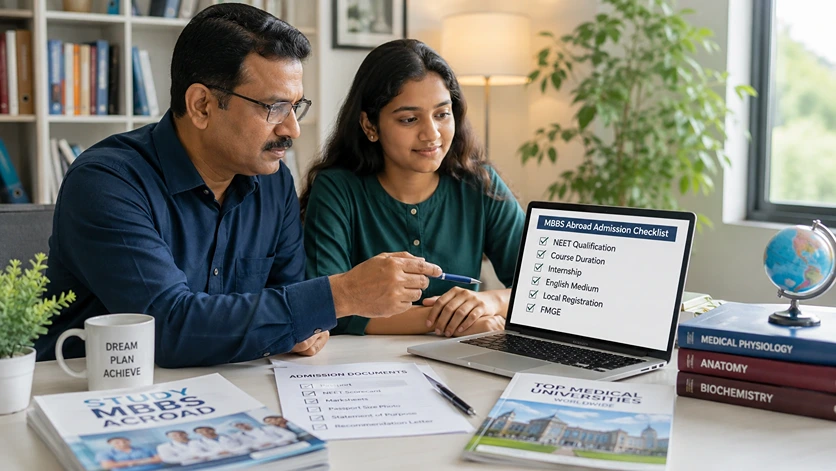
Is Foreign MBBS Valid in India?
A foreign MBBS is valid for Indian practice only after rule compliance, exam clearance, internship steps, and registration.
Yes, a foreign MBBS can be valid in India. But the degree alone does not give the student the right to practise medicine in India.
For most current MBBS abroad students, the safer pathway includes qualifying NEET, studying in a course that matches NMC conditions, completing the required duration, finishing internship, being eligible for registration in the country where the degree is awarded, clearing the required Indian screening or licensing exam, and completing medical council registration.
The NEET UG portal describes NEET UG as the common and uniform test for admission to undergraduate medical education in medical institutions. NMC’s Foreign Medical Graduate Licentiate rules and advisories refer to core points such as minimum course duration, internship, and English-medium instruction. NBEMS states in the FMGE June 2026 bulletin that a candidate passes only after scoring at least 150 out of 300.
| Requirement | What Students Must Check | Why It Matters | Date to Recheck |
|---|---|---|---|
| NEET Qualification | Student should qualify NEET before admission abroad. | NEET is a key entry requirement for Indian medical aspirants. | Before Admission Year |
| Course Duration | Course should meet the NMC-required medical education duration. | Short or unclear courses may create registration issues. | Before Fee Payment |
| Internship | Internship should match NMC conditions. | Missing internship proof can delay Indian registration. | Before Final-Year Completion |
| English Medium | Medical training should be in English. | Non-English instruction can affect compliance. | Before Admission |
| Local Registration Right | Degree should allow registration or licensing in the country of study. | India checks whether the qualification is valid in the awarding country. | Before Admission |
| Indian Licensing Exam | Student must clear FMGE or the applicable NMC-mandated test. | Required before medical registration and practice in India. | Before Returning to India |
Trade-off: A university with stronger documentation may take longer to verify, but it gives parents better protection if questions arise later.
NEET Requirement for MBBS Abroad
Indian students should treat NEET qualification as a first-step requirement before MBBS abroad admission.
NEET is one of the first points Indian students and parents should check before planning MBBS abroad. The official NEET UG portal states that NEET UG is the common and uniform entrance test for undergraduate medical education.
Parents should keep the NEET scorecard safely because it may be required during future eligibility and registration-related steps. The admission date, NEET result date, passport details, and university admission documents should also be kept in one folder.
Unpopular truth: A student should not depend on verbal claims like “NEET is not needed.” For Indian students who plan to return and practise in India, NEET should be checked before admission.
Course Duration and Internship Rules
Course length and internship proof are as important as the university name.
Parents often ask, “Which country is best for MBBS abroad?” A better question is, “Does this course meet the required duration and internship conditions?”
NMC’s Foreign Medical Graduate Licentiate Regulations refer to a foreign medical course of at least 54 months and internship of 12 months. NMC advisories have also reminded students about minimum education duration and internship requirements in the same foreign university pathway.
Before paying fees, parents should ask the university for the official academic calendar, complete curriculum, internship policy, hospital training details, and internship completion certificate format.
Trade-off: A shorter or unclear course may look convenient at first, but it can create problems when the student applies for Indian registration.
English Medium and Local Registration Eligibility
The course should be taught in English and should allow registration in the country where the degree is awarded.
English-medium instruction matters because NMC rules and advisories refer to English as the medium of instruction for foreign medical graduates. Parents should not rely only on website claims. They should ask for an official English-medium certificate from the university.
Local registration eligibility is also important. This means the degree should allow the student to be registered or licensed in the country where the medical qualification is awarded. If the degree is not accepted for medical registration in that country, it can create concerns for the Indian registration pathway.
Practical parent check: Ask the university or local medical regulator this question in writing: “After completing this course and internship, is the graduate eligible for medical registration or licence in this country?”
FMGE and Indian Licensing Pathway
Clearing the required Indian screening or licensing exam is necessary before medical practice in India.
At present, eligible foreign medical graduates appear for FMGE, conducted by NBEMS. The FMGE June 2026 bulletin says the exam has 300 multiple-choice questions and a candidate must obtain at least 150 out of 300 to pass.
Students should not think of FMGE preparation as something to start only after graduation. The better approach is to build strong basics from the first year of medical school. Anatomy, physiology, pathology, pharmacology, medicine, surgery, obstetrics and gynaecology, paediatrics, and community medicine should be studied with Indian exam expectations in mind.
Unpopular truth: FMGE is not just a final hurdle. It reflects the quality of learning built over the full course.
Common Mistakes and Red Flags
Most foreign MBBS problems begin before admission, not during the final exam stage.
Parents should be careful if they hear claims such as “NEET is not needed,” “this is an NMC approved university,” “the course is shorter but still fine,” “English certificate can be arranged later,” or “FMGE is only a formality.”
NMC has advised students to be cautious before taking admission in foreign medical institutions and has pointed students toward FMGL requirements such as course duration, internship, English medium, and mandatory subjects.
Other red flags include unclear internship locations, no written local registration proof, fee-only counselling, missing refund terms, and pressure to pay before documents are verified.
Price and convenience trade-off: Fast admission may feel comfortable when deadlines are close, but rushed admission without written proof can create long-term risk.
Case Study: Two Families Choosing MBBS Abroad
A family that saves proof before admission is better protected after graduation.
Imagine two Indian students comparing MBBS abroad options.
Student A chooses the cheaper university because the first-year fee is lower. The family receives a glossy brochure, but the course duration, internship structure, English-medium proof, and local registration pathway are not clearly documented.
Student B chooses a university only after collecting written proof of course length, internship, medium of instruction, and eligibility for local registration. The fee is slightly higher, but the family has a complete file.
Student B has made the safer decision. Not because the university is costlier, but because the rule proof is clearer.
A counselling brand such as helpabroadconsultancy can add real value by helping families create a “proof before payment” folder. This folder should include the NEET scorecard, admission letter, official curriculum, internship policy, English-medium certificate, fee terms, refund terms, and local registration proof.
Original data idea: Survey 25 Indian students who joined MBBS abroad and ask which documents they checked before admission. Publish the percentage who verified NEET, course duration, internship, English medium, and local registration before paying fees. This gives the blog first-hand insight instead of repeating common advice.
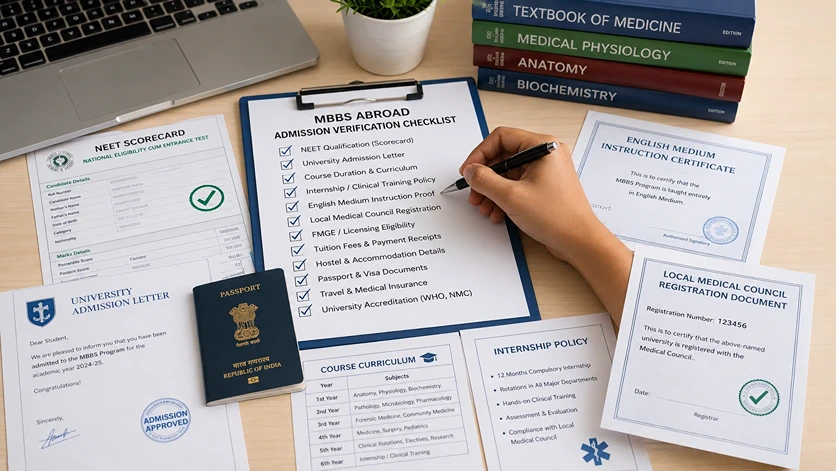
Parent Checklist Before Admission
Parents should collect documents first and compare universities second.
Before admission, parents should confirm NEET qualification, save the latest NMC and NBEMS source pages, ask for the full curriculum, confirm course duration in months, collect internship details, collect English-medium proof, check whether graduates can register in that country, and save all fee and refund terms.
Before the student returns to India, the family should collect the final degree certificate, transcripts, internship completion proof, local registration or eligibility proof, latest FMGE or applicable exam bulletin, scorecard after passing, and registration application documents.
| Document / Proof | Ask Before Paying Fees | Keep as Evidence | Date to Recheck |
|---|---|---|---|
| NEET Scorecard | Has the student qualified NEET? | Scorecard PDF | Admission Year |
| Admission Letter | Is the course clearly a medical qualification? | University Admission Letter | Before First Payment |
| Course Curriculum | Is the course duration NMC-compliant? | Official Curriculum PDF | Before Visa Filing |
| Internship Policy | Where and how is internship completed? | Internship Policy Document | Before Final Admission Confirmation |
| English-Medium Certificate | Is the full course taught in English? | University Certificate | Before Travel |
| Local Registration Proof | Can graduates register in that country? | Regulator or University Proof | Before Fee Payment |
| Fee and Refund Terms | What happens if visa or eligibility fails? | Signed Fee Document | Before Payment |
Proof parents should keep: PDFs, screenshots, official emails, signed documents, date of verification, and contact details of the person or office that confirmed the information.
Myth vs Fact: MBBS Abroad Validity in India
Good MBBS abroad decisions come from rule checks, not country popularity.
Myth: Any foreign MBBS degree is enough to practise in India.
Fact: The student must meet NMC conditions, clear the required exam, complete internship steps, and obtain registration.
Myth: A consultant’s approved list is final proof.
Fact: NMC says it does not endorse a list of foreign medical institutions or universities for MBBS or equivalent courses.
Myth: FMGE preparation can start only after graduation.
Fact: Students who build strong basics from year one usually face less pressure later.
Myth: A cheaper university is always the better choice.
Fact: Lower fees are useful only when the course also meets registration and licensing requirements.
FAQs
Parents should ask direct questions before choosing an MBBS abroad university.
Yes, foreign MBBS can be valid in India, but only when the student meets the applicable NMC rules, clears the required screening or licensing exam, completes internship steps, and obtains medical registration. The degree alone does not give practice rights in India.
Indian medical aspirants should treat NEET qualification as a key requirement before pursuing MBBS or equivalent medical education abroad. NEET UG is the common and uniform entrance test for undergraduate medical education in India.
NMC says it does not endorse any list of foreign medical institutions or universities for MBBS or equivalent courses. Parents should verify the course pathway instead of depending on “approved list” claims.
NMC’s Foreign Medical Graduate Licentiate Regulations refer to a minimum 54-month foreign medical course. Parents should confirm the exact duration through official university documents before paying fees.
Yes. NMC rules and advisories refer to a 12-month internship requirement for foreign medical graduates. Students should keep official proof of internship completion because it can affect registration steps in India.
The FMGE June 2026 bulletin says a candidate must score at least 150 out of 300 to pass. NBEMS also states that FMGE results are declared as pass or fail.
A foreign MBBS is safest when parents verify the full pathway before admission.
A foreign MBBS can be valid in India, but only when the student follows the correct rule pathway. NEET, course duration, internship, English medium, local registration eligibility, FMGE or the applicable licensing exam, and medical council registration all matter.
Parents should not depend only on country popularity, low fees, or verbal promises. They should collect written proof before paying fees. A few days of careful checking before admission can prevent years of confusion after graduation.
The safest approach is simple: verify first, pay later, and keep every document.
Planning MBBS Abroad?
Get expert guidance on eligibility, university selection, and NMC compliance before admission.
Book a Free Consultation →