
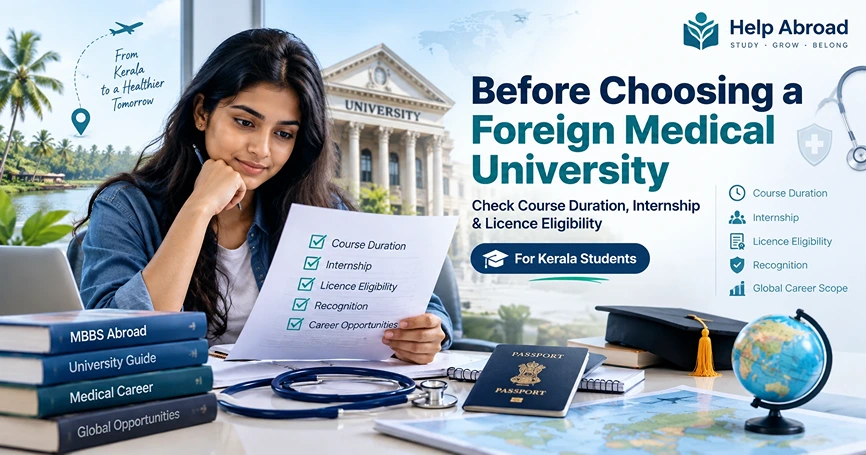
Choosing a foreign medical university is a major decision for students and parents. Fees, university ranking, country, hostel facilities and admission process are important, but they should not be the only factors.
For Indian students planning to return home and practise medicine, four questions deserve much more attention:
Is the course long enough? Is the internship properly structured? Will the student receive real clinical training? And will the qualification make the graduate eligible for a medical licence in the country where the degree is awarded?
A problem in any one of these areas may create difficulties several years later, when the student applies for internship, examination or medical registration in India.
Why Programme Structure Matters More Than Marketing
Two universities may both advertise a “six-year medical programme,” but their actual structures can be very different.
One university may provide the required academic study, hospital-based clinical training and internship within a clearly documented programme. Another may include a foundation year, offer limited hospital exposure or expect international students to arrange part of their internship elsewhere.
That difference matters.
Under the Foreign Medical Graduate Licentiate Regulations, 2021, students covered by the regulations need a foreign medical course of at least 54 months and an internship of at least 12 months in the same foreign medical institution. NMC’s FAQ also distinguishes clinical postings during the medical course from the internship completed after the course.
So, before asking, “Which country is cheaper?”, students should first ask:
“Does this exact programme meet the requirements I may need after graduation?”
1. Check the Actual Course Duration
The first step is to find out what the advertised course duration actually includes.
Do not assume that terms such as “6-year MBBS,” “5+1 programme” or “international MD” automatically mean the course meets Indian requirements.
Ask the university for its official curriculum and academic calendar.
The documents should make it possible to identify the academic study period, clinical rotations, final examinations and internship separately.
For students governed by the 2021 FMGL Regulations, NMC’s published FAQ states that the foreign medical degree course should have a minimum duration of 54 months. The internship is a separate phase and should have a minimum duration of 12 months in the same foreign medical institution.
This is why simply counting the number of years printed in a brochure is not enough.
For example, if a programme is advertised as six years, students should find out whether all six years form part of the recognised medical curriculum or whether some months are used for language preparation, foundation study or other activities.
2. Understand the Internship Before Admission
Internship should not be treated as something to check after completing the degree.
Students need to understand the internship arrangement before joining the university.
The university should clearly confirm the internship duration, the institution where it will be completed, the hospitals or departments involved and whether international students are eligible to complete it.
NMC’s current guidance for students covered by the FMGL framework requires a minimum 12-month internship in the same foreign medical institution. It also requires relevant foreign medical graduates to undergo the applicable compulsory rotating medical internship in India.
A statement such as “You can arrange the internship later” should therefore lead to more questions.
Students should obtain the internship conditions in an official university document or email rather than depending on a verbal assurance from a representative.
3. Verify Clinical Training and Teaching Hospitals
A university may advertise several affiliated hospitals. That does not automatically tell you what medical students actually do inside those hospitals.
Clinical training is different from simply visiting a hospital.
Students should find out when hospital rotations begin, which departments they rotate through, whether they interact with patients, how their attendance and clinical work are recorded, and whether international students are legally permitted to participate.
NMC’s FAQ makes an important distinction: clinical posting and training form part of the 54-month medical course, while internship is a separate practical-learning phase after completion of the course.
Language also deserves attention.
A university may teach classroom subjects in English while most patients and hospital staff speak another language. This does not automatically make the programme unsuitable, but students should understand how patient communication works and whether language training is provided before clinical rotations begin.
For a Kerala student choosing between universities, actual hospital access can be more important than campus photographs, hostel quality or the number of Indian students already studying there.
4. Check Eligibility for a Local Medical Licence
This is one of the most important checks and one of the easiest to overlook.
Students often ask whether a university is recognised, but the better question is:
“After graduating from this programme, can an international student become eligible to register or obtain a medical licence in this country?”
Under the FMGL framework, the graduate must satisfy the applicable requirement relating to registration with the professional regulatory body, or otherwise be eligible for a licence to practise medicine in the jurisdiction where the degree is awarded, at par with citizens of that country.
Students should identify the country’s official medical regulator and check the rules directly.
Do not rely only on statements such as:
“Indian students don’t need local registration.”
Instead, determine whether international graduates are legally eligible for the licensing pathway and whether there are additional examinations, language requirements, internship conditions, residency rules or other restrictions.
The exact rules differ from country to country, so this check has to be done for each destination.
Documents You Should Ask for Before Admission
A good university should be able to provide clear information instead of asking students to rely only on a brochure.
Before deciding, try to collect evidence for the following areas:
| What to Verify | Document or Proof to Request | Why It Matters |
|---|---|---|
| Course Structure | Official curriculum | Confirms academic and clinical components. |
| Course Duration | Academic calendar | Helps calculate the actual study period. |
| Internship | Internship regulations or university confirmation | Shows the internship duration and location. |
| Clinical Training | Hospital and rotation details | Shows where practical clinical training takes place. |
| Teaching Hospitals | Official affiliation information | Helps verify the relationship between the university and hospital. |
| Medium of Instruction | University confirmation | Important for applicable NMC requirements. |
| Local Registration | Medical regulator's rules | Confirms the pathway for obtaining a local medical licence. |
| Graduation Documents | Degree and internship certificate details | Important for future verification and registration processes. |
Keep copies of these documents before paying a large admission amount.
A WhatsApp message from an agent may help answer a quick question, but it should not replace an official university or regulator document when the issue concerns medical licensing.
Important Questions to Ask Before Choosing Between Universities
Instead of asking every university general questions such as “Is your university recognised?”, use specific verification questions.
Ask for the exact academic duration excluding internship. Confirm where the 12-month internship will happen and whether the same institution provides it. Ask which teaching hospitals students use and when clinical postings begin. Confirm whether international students have the same access to required clinical rotations. Find out whether any part of the programme is completed in another country or institution.
Most importantly, ask the university to identify the professional medical regulator in its country and explain whether international graduates of that exact programme can enter the local registration or licensing process.
Then verify that answer independently with the regulator.
This approach makes it much easier to compare two universities that appear similar in brochures.
Red Flags Students and Parents Should Take Seriously
Some statements should immediately lead to further verification.
Be cautious when a university or admission representative cannot clearly explain the internship structure, says students can decide where to complete internship after graduation, provides no official curriculum, refuses to give details about teaching hospitals, cannot explain whether international students are permitted to complete clinical training, or claims that local licence eligibility is irrelevant.
Another red flag is excessive dependence on the phrase “NMC approved.”
The important issue is whether the student’s individual medical programme meets the applicable NMC conditions. Course structure, internship, clinical training and licence eligibility still need to be checked.
Pressure to make a large payment before receiving these documents is another reason to slow down the decision.
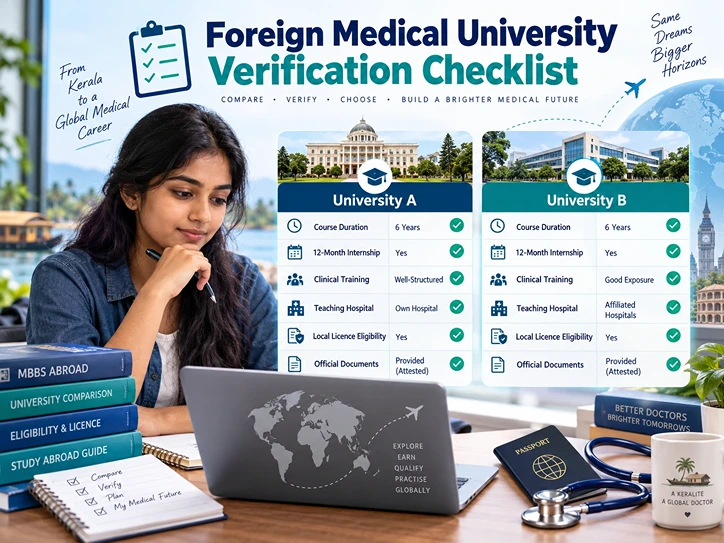
A Simple Way to Compare Two Foreign Medical Universities
Parents and students can use a basic comparison table before making the final choice.
| Check | University A | University B |
|---|---|---|
| Medical course duration confirmed | Yes / No | Yes / No |
| 12-month foreign internship confirmed | Yes / No | Yes / No |
| Internship institution identified | Yes / No | Yes / No |
| Teaching hospitals verified | Yes / No | Yes / No |
| Clinical rotations explained | Yes / No | Yes / No |
| International student clinical access confirmed | Yes / No | Yes / No |
| Local medical regulator identified | Yes / No | Yes / No |
| Licence pathway checked | Yes / No | Yes / No |
| Official documents received | Yes / No | Yes / No |
Do not treat a missing answer as a “yes.”
If one university costs slightly more but provides clear documentation while another gives vague answers about internship or licensing, the cheaper option is not automatically the better choice.
Frequently Asked Questions
Students should not treat the phrase “NMC approved university” as the only verification required. The exact programme has to satisfy the applicable NMC requirements concerning medical education, internship and other conditions.
For students covered by the 2021 FMGL Regulations, NMC’s FAQ states that the medical course should have a minimum duration of 54 months, with a minimum 12-month internship in the same foreign medical institution.
NMC’s FAQ states that clinical posting and training are part of the 54-month medical course. Internship is a separate practical-learning phase completed after the medical course.
Students should not assume that they can. For students governed by the current FMGL framework, the foreign internship requirement is tied to the same foreign medical institution. Verify the current rule for your admission category before joining.
Because the FMGL requirements include a condition related to registration or eligibility for a licence to practise medicine in the country where the qualification is awarded. Students should verify this with the official regulator rather than relying only on admission counselling.
Choosing a foreign medical university should never be based only on fees, rankings, location or attractive admission offers. Students and parents need to look closely at the actual course duration, internship structure, clinical training opportunities and local medical licence eligibility before making a decision.
The safest approach is to verify every important point through official university documents, teaching-hospital details and the relevant medical regulator. Written proof is always more reliable than verbal promises.
A few extra checks before admission can prevent serious academic, internship and licensing problems later. So before paying the fees, make sure the programme is not only affordable and popular, but also suitable for your long-term goal of becoming a licensed doctor.
Professional review advised, as medical education and registration rules can change.
Need Help Choosing the Right Foreign Medical University?
Before you make a decision, make sure the course duration, internship, clinical training and licence eligibility are properly checked.
Help Abroad Consultancy can guide you in comparing universities, understanding programme details and identifying the right questions to ask before admission.
Talk to our team before you apply and make your decision with better clarity.
Talk to Our Team