

MBBS in Uzbekistan 2027 may look affordable when a university advertises tuition of a few thousand dollars per year. But for a family in Kerala, the important figure is not the admission fee. It is the amount they may need to spend until their child completes the required medical education and training.
A course with lower tuition can become more expensive because of accommodation, food, additional academic charges or delays. Meanwhile, a university with slightly higher tuition might offer a more predictable budget.
There is also a question that money cannot solve: does the chosen programme meet the Indian medical registration requirements?
This guide takes a different approach to the usual country-fee comparison. It examines published tuition, tests several family budgets and shows how to identify costs and risks before paying an admission deposit.
What Makes Uzbekistan Medical Education Costs Difficult to Compare?
Tuition, living expenses and regulatory eligibility are three separate questions; none should be answered using a promotional package alone.
Uzbekistan’s official international higher-education portal describes General Medicine as a six-year programme. Indian applicants commonly search for such degrees using the term MBBS.
However, a six-year course description alone cannot confirm whether the programme satisfies India’s education and internship requirements.
Similarly, university fee information may use Uzbek soum, with an approximate dollar equivalent. The amount ultimately paid can depend on the contract currency and the payment conversion process.
Kerala families should therefore separate information into three categories:
- Confirmed information: Details stated in official university or regulatory documents.
- Planning assumptions: Figures used to prepare a household budget.
- Unconfirmed 2027 details: Future tuition, admission dates, hostel availability and academic policies that require updated written confirmation.
That distinction prevents an estimate from being mistaken for a guaranteed offer.
Eight Expenses Kerala Parents Should Investigate
The most important hidden expenses are often recurring charges, unplanned academic costs and payments excluded from the initial quotation.
1. Hostel rent that excludes everyday services
A hostel price may not include electricity, heating, laundry, internet or meals.
Students should also ask whether accommodation is guaranteed for every academic year. A first-year hostel offer does not necessarily establish availability throughout the course.
2. Food and access to cooking facilities
A Kerala student accustomed to home-cooked meals may find that food expenses depend heavily on kitchen access.
A shared kitchen could reduce spending, but families should verify permission to cook, grocery availability and the cost of basic supplies.
Indian-food availability should be checked at the exact campus rather than assumed from the city’s student population.
3. Winter preparation
For a student arriving from Kerala, winter clothing and suitable footwear are practical expenses that may not appear in a university quotation.
Ask whether the accommodation provides adequate heating and whether heating charges are included.
4. Flights home
A family may want its child to visit Kerala during longer academic breaks.
But annual flight costs should not be treated as fixed. Prices depend on routes, travel dates, baggage needs and the number of journeys.
It is better to obtain current quotations and allocate a travel allowance than assume an unverified return-ticket price.
5. Student visa and registration
Uzbekistan’s official visa information describes an A-1 student visa issued on the basis of an educational institution’s request.
Students should confirm the current application requirements, registration procedures, fees and renewal arrangements.
Visa eligibility and fees for 2027 must be checked with the competent authorities.
6. Examination repeats
A failed examination may affect academic progression and living expenses.
No verified universal rule establishes free re-examinations for all medical universities in Uzbekistan.
Ask whether repeat attempts incur charges and whether a failed subject can delay the next semester or clinical training.
7. Currency changes
Suppose a university charges $3,200 annually.
If the planning exchange rate changes from ₹94.40 to ₹99.40, annual tuition becomes ₹16,000 more expensive.
Across six identical tuition payments, that would represent an additional ₹96,000, assuming the higher rate applied to all payments.
This is an exchange-rate sensitivity example, not a prediction.
Families should also confirm whether the legal fee is actually denominated in dollars or Uzbek soum.
8. Additional months abroad
Consider an unexpected six-month extension.
At an assumed monthly living cost of $550, the student would need another $3,300 for living expenses alone.
At the reference exchange rate, this is approximately ₹3.12 lakh before any additional tuition, visa or academic charges.
The most useful precaution is to request the university’s current academic progression and internship policies in writing.
NEET, Clinical Training and NMC Rules for 2027 Applicants
A medical degree’s affordability has little practical value if the programme fails to meet the requirements relevant to Indian registration.
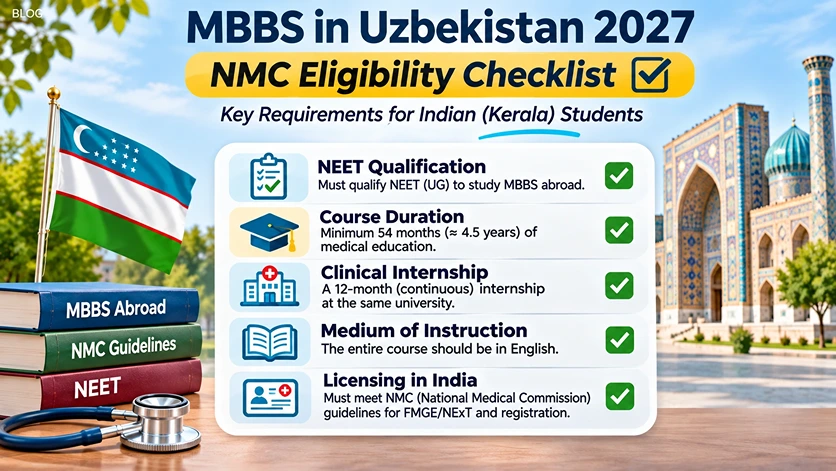
Indian citizens and Overseas Citizens of India planning undergraduate medical education abroad must satisfy the applicable NEET eligibility conditions. Students entering in 2027 should use the official bulletin and regulatory rules relevant to that admission year.
India’s Foreign Medical Graduate Licentiate Regulations, 2021, establish requirements that include:
- A minimum of 54 months of education in the same foreign institution.
- A separate 12-month internship at the same foreign institution.
- English as the medium of instruction.
- Required medical subjects and appropriate clinical training.
- Eligibility to obtain the relevant licence or registration in the country awarding the qualification.
- Applicable Indian screening, internship and registration procedures.
The NMC issued a specific advisory about medical education in Uzbekistan on 1 April 2026. It identified concerns involving Bukhara State Medical Institute, Samarkand State Medical University, Tashkent State Medical University and an offshore arrangement involving the Tashkent State Medical University Termez branch.
The advisory raised concerns about matters such as clinical training, programme compliance and reported admission practices. It should not be misrepresented as a declaration that every Uzbek institution is prohibited.
Bukhara State Medical Institute separately announced a temporary suspension of Indian student admissions for 2026–27. That notice does not establish whether its admissions will resume for 2027–28.
For any shortlisted university, the student should obtain the course structure, internship details and current admission notice before making a financial commitment.
Professional review advised: Medical licensing and regulatory eligibility should be independently assessed using the applicable official rules.
Common Myths That Can Mislead Applicants
Promises of guaranteed registration, universal approval or fixed lifetime costs need documentary proof and should not be accepted at face value.
| Myth | What Parents Should Understand |
|---|---|
| Every Uzbek medical university is NMC approved. | NMC does not endorse a blanket list of foreign medical universities. |
| English-medium admission guarantees English clinical training. | The actual teaching, examinations and clinical arrangements must be verified. |
| The six-year tuition total is the complete budget. | Living expenses and other payments can form a substantial part of the cost. |
| An agent can guarantee medical registration in India. | Graduates must satisfy the applicable regulatory requirements. |
| Students can always repeat failed exams without extra charges. | Each university's current policy must be checked. |
An especially important warning sign is pressure to pay immediately before the university has issued an official admission offer or itemised contract.
A Kerala Family's University Comparison Exercise
The best-value university is one whose total costs and academic arrangements can be independently examined, not simply the cheapest advertiser.
Imagine a student from Thrissur who receives information about two medical universities.
The first offers attractive tuition but gives only a broad estimate for accommodation. The second publishes a higher tuition figure but provides a clearer breakdown of hostel charges, compulsory payments and clinical training arrangements.
The student’s parents prepare a comparison worksheet instead of deciding immediately.
They ask both institutions the same questions: Who awards the degree? Which hospital provides the clinical placements? Where will the internship take place? Who receives tuition payments? What happens if the student fails a subject? What is refundable if admission cannot proceed?
The family discovers that the most important difference is not the initial tuition. It is the amount of reliable information available for making a long-term decision.
This is an illustrative scenario, not a claim about an actual family or particular university.
How to collect original student evidence
Before finalising a choice, families can speak with several current students enrolled in the exact programme and campus.
Ask them to maintain a simple spending diary covering accommodation, meals, groceries, transport and miscellaneous expenses for one month. Record when the data was collected and whether the amounts include university-provided meals or housing.
Collecting such evidence with consent gives a clearer picture than repeating general estimates from promotional websites. Individual student accounts still need to be treated as personal experiences rather than universal findings.
Two Checklists Before Paying an Admission Deposit
Written financial and academic verification helps families identify missing information before making payments that may be difficult to recover.
Academic checklist
- Verify the institution, campus and exact General Medicine programme.
- Check NEET eligibility and applicable NMC rules.
- Confirm the language of instruction and clinical training.
- Request internship and academic progression documents.
- Review the latest institution-specific admission notices.
Evidence to keep: Dated admission letters, course regulations, university emails and official notices.
Financial checklist
- Obtain the full-duration tuition schedule.
- Confirm whether hostel, food and insurance are included.
- Ask for examination-repeat and refund policies.
- Verify bank details directly with the university.
- Prepare a budget for travel, living expenses and emergencies.
Evidence to keep: Signed quotations, accommodation agreements, bank receipts and a dated household cost worksheet.
Frequently Asked Questions
There is no confirmed universal 2027 cost. Official university listings provide tuition examples, while the complete amount depends on living expenses, course duration, recurring charges and possible delays. Families should calculate their own budget from written quotations.
Some Uzbek programmes publish lower annual tuition than expensive Indian private medical programmes. However, a valid comparison requires the complete cost of study, the required internship and the pathway to professional registration. Individual colleges may differ significantly.
Some institutions list English-language General Medicine programmes. Students must verify actual teaching, assessment and clinical arrangements for the exact course. A university offering English in one programme does not mean all its medical programmes use English.
Indian applicants intending to obtain an undergraduate medical qualification abroad must meet applicable NEET qualification requirements. The official 2027 admission-year guidance should be checked when available.
Not necessarily. University fee quotations may exclude accommodation and meals. Ask for a separate hostel contract showing the charges, covered services and payment duration.
The consequences depend on the university’s assessment rules. Repeat examination charges, extra study periods and progression conditions should be confirmed through current written regulations.
Potentially, if the qualification and graduate meet the relevant Indian medical education, screening, internship and registration requirements. Registration is not automatic or guaranteed.
The most responsible admission decision balances manageable costs, transparent university policies and verifiable medical education requirements.
For Kerala families considering MBBS in Uzbekistan in 2027, the key question is not simply how little the first year will cost.
It is whether the family can fund the entire programme, understand the consequences of unexpected delays and verify that the university provides the academic and clinical training required for the student’s professional plans.
Students comparing universities can seek documentation and application guidance from help abroad consultancy, while independently confirming important regulatory and financial details with official authorities.
A realistic budget, supported by university documents and current regulations, is a stronger foundation for a medical education decision than an attractive admission package.
Professional review advised for licensing and regulatory decisions.
Planning MBBS in Uzbekistan in 2027?
Choosing the right medical university involves more than comparing tuition fees. Help Abroad Consultancy can guide Kerala students and parents through university comparisons, admission requirements, estimated expenses and documentation.
Get clear guidance before making your decision.
Get Free MBBS Admission Guidance