


Paying an overseas university can mean transferring several lakhs of rupees in one transaction. For Kerala parents, the challenge is not just arranging the funds. It is making sure the correct amount reaches the correct university account, in the required currency and before the deadline.
International tuition payments involve foreign-currency conversion, beneficiary details, student payment references and international settlement. Families may also need to understand India’s Liberalised Remittance Scheme (LRS) and Tax Collected at Source (TCS) rules.
A payment can go wrong without the money actually being lost. For example, the university may receive the funds but struggle to identify the student because the payment reference is missing. A forex quote can also appear inexpensive until exchange-rate margins or additional charges are considered.
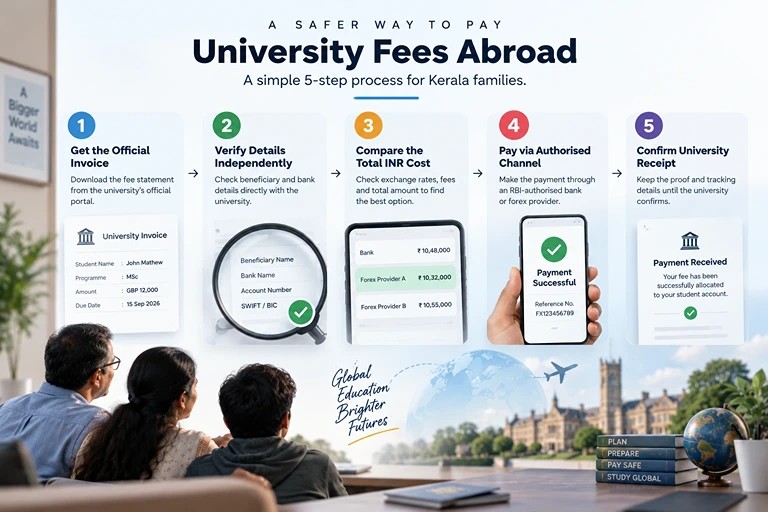
The safest approach is systematic:
VERIFY → COMPARE → PAY → PROVE
This guide explains how Kerala families can follow that process without making overseas university payments more complicated than necessary.
How to Pay University Fees Abroad Safely: 7 Steps
1. Get the Official University Invoice
Start with the university, not with a forex quote.
Universities usually provide fee statements through a student portal, finance portal, admissions account or official university email. Some institutions direct international students to an approved payment platform.
Check that the invoice clearly shows:
- Student name or identification number
- Amount due and required currency
- Payment deadline
- Beneficiary and bank details where relevant
- IBAN, SWIFT or BIC details if required
- Student, applicant or invoice reference
The required currency matters. If the university asks for GBP, CAD, EUR or another currency, the payment should be arranged so the institution receives the amount it expects in that currency.
Pay attention to the deadline too. The date money leaves your Indian account may not be the same date the university receives and allocates it.
Do not wait until the final deadline to begin arranging the remittance. Documentation checks, compliance review, forex processing, intermediary banks and university reconciliation can all add time.
If the invoice and student portal show different amounts or payment instructions, ask the university which information is current before proceeding.
2. Verify Beneficiary Details Independently
For a high-value international payment, beneficiary verification deserves a separate check.
Compare the beneficiary name, bank information and payment currency with the university’s official portal or other verified instructions. If anything has changed, contact the university finance team using contact information obtained independently.
This matters because compromised email accounts can be used to send convincing messages with altered bank details.
For example, imagine a Kerala parent receives an email two days before the deadline saying the university has changed its bank account. Instead of replying to that email, the parent logs directly into the official student portal or contacts the university finance office using details already published on its website.
That independent channel is the important part.
A sudden bank change does not automatically mean fraud, but it should always trigger another verification step.
A changed beneficiary should trigger verification, not faster payment.
Do not confirm a new account using only the phone number, website link or contact information contained in the message announcing the change.
3. Use an RBI-Authorised Payment Channel
For a high-value international payment, beneficiary verification deserves a separate check.
Compare the beneficiary name, bank information and payment currency with the university’s official portal or other verified instructions. If anything has changed, contact the university finance team using contact information obtained independently.
This matters because compromised email accounts can be used to send convincing messages with altered bank details.
For example, imagine a Kerala parent receives an email two days before the deadline saying the university has changed its bank account. Instead of replying to that email, the parent logs directly into the official student portal or contacts the university finance office using details already published on its website.
That independent channel is the important part.
A sudden bank change does not automatically mean fraud, but it should always trigger another verification step.
A changed beneficiary should trigger verification, not faster payment.
Do not confirm a new account using only the phone number, website link or contact information contained in the message announcing the change.
4. Compare the Total INR Cost
The exchange rate alone does not show the true cost of paying university fees abroad.
The final amount may be affected by the exchange-rate margin, provider charges, processing fees, possible correspondent-bank deductions and applicable TCS. Settlement time and tracking also matter, especially when a deadline is approaching.
Ask every provider:
“How many rupees will leave my account for the university to receive the exact amount shown on the invoice?”
Use that answer as the starting point for comparison.
Consider two providers conceptually. Provider A may advertise a lower transfer fee but apply a weaker exchange rate. Provider B may show a visible service fee but still require fewer rupees overall for the university to receive the same amount.
Neither headline tells the full story.
Request comparable quotes at roughly the same time because currency rates can move.
| Factor | What to Check | Why It Matters |
|---|---|---|
| University receivable | Exact foreign-currency amount | Confirms the fee will be paid in full |
| Exchange rate | Rate applied to your transaction | Small differences matter on large amounts |
| Total INR debit | Complete rupee outflow | Gives the clearest cost comparison |
| Charges | Provider and processing fees | May sit outside the headline rate |
| Intermediary costs | Possible correspondent-bank deductions | Can affect the amount received |
| Settlement | Expected processing time | Matters near fee deadlines |
| Tracking | SWIFT or remittance reference | Helps trace the payment |
Consider two providers conceptually. Provider A may advertise a lower transfer fee but apply a weaker exchange rate. Provider B may show a visible service fee but still require fewer rupees overall for the university to receive the same amount.
Neither headline tells the full story.
Request comparable quotes at roughly the same time because currency rates can move.
5. Understand LRS and TCS Before Paying
Two terms often appear for the first time when parents arrange an overseas education remittance: LRS and TCS. They cover different parts of the transaction.
What is LRS?
LRS stands for the Liberalised Remittance Scheme. It is RBI’s framework allowing resident individuals to remit money abroad for permitted current and capital-account transactions.
The general LRS limit is USD 250,000 per resident individual per financial year. A financial year runs from April to March, and studies abroad are a permitted purpose.
Education also receives specific treatment when the required amount is higher.
RBI states that AD Category I banks and AD Category II entities may release up to USD 250,000 for studies abroad without requiring an estimate from the overseas university. They may also allow education remittances above USD 250,000 without prior RBI approval when supported by an estimate from the institution abroad.
For a high-value programme, parents should therefore speak to the authorised dealer early and ask which university documents are required rather than assuming the normal online process will be sufficient.
What is TCS?
TCS means Tax Collected at Source. It is a tax-collection mechanism and is separate from a provider’s transfer fee or exchange-rate margin.
Under Section 394 of the Income-tax Act, 2025, the LRS provision applies where the amount or aggregate of LRS remittances exceeds ₹10 lakh. For education and medical-treatment remittances where TCS applies, the rate is 2% from 1 April 2026.
Section 394 also provides an exclusion from this LRS TCS collection where the amount being remitted is from a qualifying loan obtained from the financial institution specified in the Act for pursuing education.
| Rule | Current Position |
|---|---|
| General LRS limit | USD 250,000 per resident individual per financial year |
| Studies abroad | Permitted under LRS |
| Education above USD 250,000 | Specified authorised dealers may process based on the institution’s estimate |
| LRS TCS threshold | Amount or aggregate exceeding ₹10 lakh |
| Education/medical TCS rate where applicable | 2% from 1 April 2026 |
| Qualifying education-loan remittance | Excluded from this LRS TCS collection under Section 394 |
Ask the authorised dealer to confirm how the current rules apply to your transaction, particularly if the payment is large or funded through an education loan.
Keep relevant TCS and remittance records for later tax reconciliation.
Rules and tax treatment can change. Confirm the requirements applying to your transaction with the authorised dealer and, where necessary, a qualified tax professional.
6. Enter the Correct Student Payment Reference
A transfer can reach the correct university bank account and still be delayed if the finance team cannot identify which student it belongs to.
The university may ask for a student ID, applicant number, invoice number or another specific payment reference. Enter it exactly as requested.
This detail is especially useful when parents are paying from Kerala while the student is already abroad. Both parent and student should keep the exact reference used so either person can provide it if the university asks for evidence.
If the payment system limits the number of characters, ask the provider or university which reference should take priority rather than creating your own abbreviation.
7. Save Proof and Confirm University Receipt
Do not treat the transaction as finished simply because money has left your bank account.
Save the transaction confirmation, university invoice, remittance receipt and relevant tax records. Keep the SWIFT or other tracking reference where one is available.
An international payment may pass through intermediary banks before reaching the university. Even after receipt, the university finance team may need time to match the payment to the student’s account.
That means a student portal may not update instantly.
If the payment is not showing after the expected processing period, provide the university finance team with the student reference, remittance receipt and tracking details.
For families coordinating between Kerala and a student overseas, keeping one shared digital folder for the invoice, payment confirmation and university receipt is usually easier than searching through different email or WhatsApp conversations later.
The safest final checkpoint is:
The university confirms that the money has been received and allocated to the correct student account.
Bank vs Forex Provider: What Should You Compare?
There is no universal answer to whether a bank or specialist remittance provider is better.
A bank may suit parents who value an existing relationship, branch assistance and a familiar documentation process. This can be useful if someone prefers to discuss a high-value transaction face to face.
An appropriately authorised specialist provider may offer a more digital workflow, education-focused documentation support or different settlement and tracking options.
The useful comparison is therefore not simply bank versus forex company.
Look at the complete experience: the total INR debit, how easily documentation can be supplied, expected settlement time, tracking availability and what support is available if the university cannot locate the payment.
For one family, branch support may matter more. For another, an efficient digital process may be more convenient.
The right option is the authorised route that gives you a clear cost, clear documentation and confidence that the payment can be tracked from your account to the university.
A Practical University Fee Payment Example
Consider a Kerala family whose student receives a semester invoice from a UK university in GBP.
The parent first downloads the invoice from the official university portal and checks the amount, deadline and student reference. They then independently confirm that the beneficiary information matches the university’s verified payment instructions.
Next, the family requests comparable quotes from appropriately authorised payment channels. Instead of comparing only the GBP/INR rate, they compare the total INR amount required for the university to receive the invoice value.
They ask the chosen provider how the transaction will be handled under LRS and whether TCS applies to their circumstances.
The parent then sends the payment using the exact student reference and saves the remittance confirmation.
The student later checks the university portal. If the fee is not allocated after the expected processing period, the family already has the reference and payment evidence needed to contact the finance team.
No live exchange-rate or tax calculation is needed to follow this process. What matters is the sequence.
University Fee Payment Scam Warning Signs
Unexpected bank-detail change
Universities can legitimately change bank accounts, but a sudden change should be independently confirmed before money is sent.
Personal or unrelated beneficiary
Do not casually redirect tuition fees to an individual or unrelated third party because a message instructs you to do so.
Instructions only through WhatsApp or an unfamiliar email
WhatsApp is useful for family coordination, but it should not be the sole source of beneficiary information for a large university payment.
Extreme urgency
Real deadlines exist, but pressure to make an immediate transfer to newly supplied details should not replace normal verification.
Request to misstate the payment purpose
Give the authorised dealer accurate information about the education transaction. Do not describe the remittance differently simply to make processing appear easier.
Provider cannot explain its authorisation
If a provider cannot clearly explain which authorised entity is processing the foreign exchange, verify its status before proceeding. RBI says resident persons should transact in forex only with authorised persons for permitted purposes.
VERIFY → COMPARE → PAY → PROVE
VERIFY
Confirm the official invoice, beneficiary, amount, currency, deadline and student reference.
COMPARE
Compare appropriately authorised payment routes by total INR cost, processing support, settlement time and tracking.
PAY
Recheck the beneficiary, payment purpose, amount and student reference before authorising the transaction.
PROVE
Keep the receipt and tracking details until the university confirms that the payment has been allocated.
FAQs
Use the official university invoice, independently verify the beneficiary and make the payment through an appropriately RBI-authorised channel. Compare the total INR cost, check applicable LRS and TCS requirements, enter the correct student reference and retain the payment evidence until the university confirms allocation.
The general LRS limit is USD 250,000 per resident individual per financial year. Studies abroad are a permitted purpose. RBI also provides specific treatment for education payments above this amount when supported by an estimate from the overseas institution.How does TCS apply to overseas university payments?
Under the rules in force from 1 April 2026, the LRS threshold is ₹10 lakh, and education or medical-treatment remittances subject to TCS carry a 2% rate. Qualifying education-loan-funded remittances receive the exclusion provided under Section 394.
RBI allows specified authorised dealers to process education remittances above USD 250,000 without prior RBI approval when supported by an estimate from the overseas educational institution. Families should ask the authorised dealer which documents are required before arranging a high-value payment.
Either may be suitable. Compare the total INR cost, documentation support, expected settlement time, tracking and help available if the university cannot locate the payment. The provider category alone does not determine which option is better for your family.
Check the student portal or contact the university finance office after the provider’s expected processing period. Keep the remittance receipt and tracking reference available. The strongest confirmation is that the university has not only received the money but also allocated it to the correct student’s account.
Need Help With Your Overseas University Payment Process?
Not sure which university documents to check before arranging your fee payment? Help Abroad Consultancy can guide students and parents through university fee requirements, documentation, and the study-abroad process so you can move forward with clarity.
Talk to Our Study Abroad Team →
1 Comment