


Choosing a foreign medical university is a major decision. For students from Kerala, it can mean spending several years away from home, adapting to a new country, studying in a different academic system, and preparing for the requirements needed to continue a medical career in India.
University websites and brochures can explain courses, campuses, hospitals, and facilities. But they may not show what everyday student life is actually like.
That is why you should speak with current students before selecting a foreign medical university.
Current students can give you practical information about teaching, clinical exposure, accommodation, food, living expenses, safety, student support, and the challenges they faced after joining.
But avoid asking only:
“Is this university good?”
A simple yes or no will not tell you much. Ask specific questions that encourage students to describe their actual experiences.
Current students are useful for understanding student life. Official matters such as course structure, internship arrangements, eligibility, and regulatory requirements should be verified separately through the university and relevant official authorities.
Why Should You Speak With Current Students?
There can be a difference between what a university advertises and what students experience every day.
A university may say that it provides good clinical exposure. A current student can explain how often they actually attend the hospital, whether they interact with patients, and whether language affects clinical learning.
Similarly, “hostel available” tells you very little about room sharing, cleanliness, Wi-Fi, food, heating, or the distance between the hostel and campus.
Speaking with students helps you understand these practical details before making a major financial and academic commitment.
The goal is not to find someone who will tell you whether to join. The goal is to collect enough information to make your own informed decision.
What a Normal Week of Classes Is Actually Like
Instead of asking whether the teaching is “good,” ask students to describe an ordinary academic week.
Five useful questions are:
- How many classes and practical sessions do you normally have each week?
- Are classes regularly conducted according to the timetable?
- Are professors approachable when students have doubts?
- How difficult are internal examinations?
- What is the biggest weakness in the teaching?
Also pay attention to how much independent study students need to do. Some universities may have demanding attendance schedules, while others may require students to take greater responsibility for their own learning.
For students planning to return to India, ask seniors whether their academic schedule gives them reasonable time for independent preparation for the licensing or screening requirements relevant to their batch.
Do not judge a university only by claims about special exam coaching. The quality of teaching, academic foundation, study environment, internet access, and realistic self-study time are also important.
What Students Actually Do During Hospital Postings
Clinical exposure is one of the most important areas to investigate when comparing foreign medical universities.
Do not simply ask:
“Does the university have a hospital?”
Instead, ask:
- When do regular clinical postings begin?
- How frequently do students attend hospitals?
- How many students are usually placed in one clinical group?
- Do students interact directly with patients?
- What did you personally do during your most recent hospital posting?
The final question is particularly useful.
If a student can describe taking patient histories, examining patients under supervision, discussing cases with professors, or participating in clinical activities, you get a clearer picture of what “clinical exposure” means at that university.
Also ask whether students mostly participate or observe. A university may have access to a large hospital, but that does not automatically tell you how much individual involvement students receive.
Does Language Affect Clinical Training?
An English-medium medical programme does not necessarily mean patients speak English.
Ask students whether the university teaches the local language and whether senior international students can communicate comfortably with patients.
The key issue is not simply whether language classes exist. It is whether students develop enough practical language ability to take histories, understand patients, and participate meaningfully during clinical postings.
A useful question is:
“Can senior international students communicate with patients without depending heavily on someone to translate?”
The answer can tell you a great deal about the real clinical environment.
What the Hostel Is Really Like
Hostel photographs used during admissions may not show ordinary student living conditions.
Ask current students:
- How many students normally share a room?
- Is Wi-Fi reliable enough for studying?
- Can students cook in the hostel?
- How far is the hostel from the university and teaching hospital?
- Are there any additional hostel charges?
Then discuss other practical details naturally. Ask about bathroom facilities, cleanliness, laundry, study areas, transportation, security, and hostel rules.
If the student is comfortable, ask whether they can show you their room during a video call.
Seeing an ordinary room and common area can sometimes tell you more than promotional photographs.
What About Winter?
For Kerala students considering countries with severe winters, accommodation becomes especially important.
Ask someone who has already completed at least one full winter about heating and hot-water reliability.
You should also understand what students normally spend on winter jackets, thermal clothing, footwear, bedding, and transportation during severe weather.
A student who arrived only recently may not yet know what the hostel is like during the coldest part of the year.
What Indian Students Actually Eat
“Indian food available” sounds reassuring, but it does not tell you what students actually eat every day.
Ask:
- Is Indian food regularly available?
- Can students cook their own meals?
- Are vegetarian options easily available?
- Are Indian groceries and spices easy to find?
- What do Indian students normally eat during a typical week?
For Kerala students, it may also be useful to ask about the availability and price of familiar ingredients such as rice, lentils, spices, and coconut-based products.
Food costs can also vary significantly depending on whether students cook, use a hostel mess, or regularly order from restaurants.
Ask About Everyday Language
Language matters outside the hospital too.
Students may need the local language when shopping, using taxis or public transport, visiting pharmacies, speaking with landlords, or dealing with local offices.
Ask:
“If I arrive knowing only English, what situations will be difficult during my first few months?”
This is more useful than simply asking whether people in the country speak English.
About the Real Cost of Living
A university with affordable tuition can still be expensive once daily living costs are included.
One of the best questions to ask is:
“Excluding tuition, approximately how much did you actually spend last month?”
Then focus on five main areas:
- Accommodation
- Food and groceries
- Local transportation
- Mobile, internet, and utilities
- Personal and study expenses
Do not rely on one student’s figure. Someone who cooks every day may spend much less than a student who frequently eats outside.
Ask several students and compare the answers.
Some costs also do not occur every month. These may include insurance, residence-permit renewals, medical checks, university administration charges, winter clothing, and flights to India.
For a Kerala family planning several years of medical education abroad, it is sensible to leave room in the budget for unexpected expenses and changes in living costs.
Safety Using Real Situations
“Is the country safe?” is too broad a question.
A student’s experience in the area surrounding the university is more useful for understanding everyday life.
Ask:
- Do students feel comfortable around the hostel after dark?
- How do students normally travel at night?
- Are there particular areas students avoid?
- How secure is the hostel?
- What happens when a student faces an emergency?
You can also ask whether international students have experienced common scams or difficulties and how the university responded.
Female students may find it particularly useful to speak directly with female seniors about accommodation, transport after dark, hostel security, and their everyday experiences in the city.
Remember that one student’s experience cannot prove that an entire city or country is safe or unsafe. Compare several experiences and check current official travel information separately.
What Happens When a Student Needs Help
Almost every university will say that it supports international students.
Find out what that support looks like when someone actually has a problem.
Ask:
- Is there an international student office?
- Who helps students with residence or immigration paperwork?
- What happens if a student becomes seriously ill?
- How quickly does the administration respond to problems?
- Do senior or Indian students help new students?
Then ask:
“Can you tell me about a time you needed help from the university and what happened?”
This question can reveal whether student support works in practice.
You can also discuss academic assistance, counselling, student associations, and support for students struggling to adjust to the country.
What Students Wish They Had Known Before Joining
This is one of the most valuable parts of the conversation.
Students who have already spent a year or more at the university know which problems were difficult to predict before admission.
Ask:
- What has been better than you expected?
- What has been worse than you expected?
- What was the hardest thing to adjust to?
- What do you wish you had checked before paying your fees?
- Knowing what you know now, would you choose the same university again?
Do not focus only on whether the final answer is yes or no.
Ask why.
A student may be happy with the teaching but disappointed with accommodation. Another may like the university but find the local language much harder than expected.
Understanding those trade-offs is more useful than collecting simple ratings.
A strong final question is:
“If your younger brother or sister wanted to join this university, what would you tell them to check first?”
The answer may reveal something that was missing from your original checklist.
Speak With More Than One Student
One student’s experience should not decide where you spend several years studying medicine.
Try to speak with at least three students from different stages of the programme.
A junior student can tell you about first-year academics, food, hostel life, and adjusting to the country. A clinical-year student can explain hospital postings, patient interaction, and language difficulties. A senior student may know about problems that only become visible after several years.
Whenever possible, speak with students you find independently as well as students introduced during the admission process.
Ask each student several of the same core questions.
You are looking for patterns, not testimonials.
If one student complains about something, it may simply reflect their personal experience.
If several independent students describe the same problem, it deserves closer investigation.
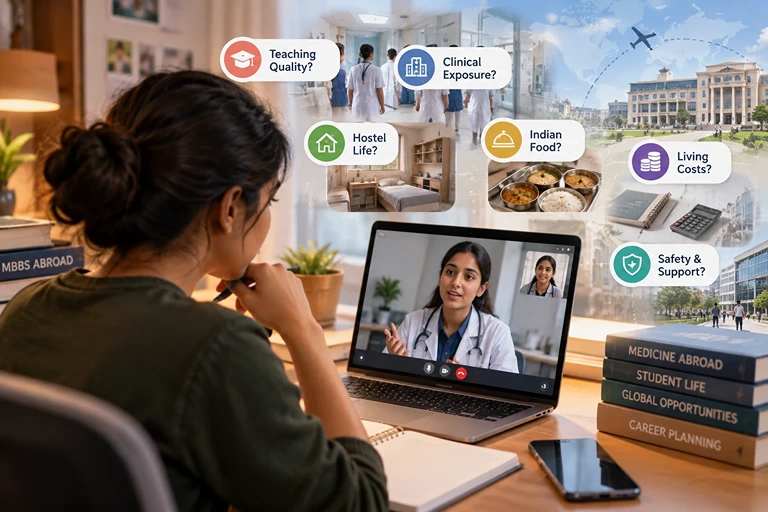
How Can You Find Current Students Independently?
Professional networks and public social platforms can help you find students who identify themselves as currently studying at the university.
Search using the university name together with terms such as “medical student,” “medicine,” or the programme name. Where possible, look for Indian students or students from Kerala who are already enrolled.
You can introduce yourself with a short message:
“Hi, I’m a student from Kerala considering your university for medicine. Would you be comfortable answering a few questions about your experience there?”
Keep the first conversation respectful. Do not immediately request private information, personal documents, or phone numbers.
The aim is to speak with a small number of credible students from different years rather than collecting dozens of random online opinions.
Red Flags to Investigate Before Paying Fees
No university is perfect, and one negative comment should not automatically rule out an institution.
However, investigate further when several independent students mention the same problem.
Five areas deserve particular attention:
- Classes are frequently cancelled or teaching is inconsistent.
- Students receive very little meaningful patient interaction.
- Language seriously limits clinical learning.
- Hostel conditions differ substantially from what was advertised.
- Students repeatedly report unexpected fees or difficulty getting help.
Other concerns may appear during your conversations. For example, students may struggle to find enough independent study time, experience repeated accommodation problems, or give unclear answers about how clinical training works.
Do not ignore a concern simply because it is not included on a standard checklist.
The goal is not to find a university with zero disadvantages.
The goal is to understand the disadvantages before you commit.
Students About Experience, but Verify Official Information
Current students are useful sources for understanding everyday life.
They can tell you about teaching, clinical postings, accommodation, food, transportation, expenses, language difficulties, and student support.
However, students should not be your only source for official matters.
Course duration, curriculum, internship arrangements, eligibility, licensing requirements, and regulations affecting foreign medical graduates need separate verification through current official documentation.
This is particularly important because requirements can change between admission years.
Do not assume that the pathway followed by a senior student will automatically be identical to the pathway that applies to you.
A useful rule is simple:
Ask students about experience. Ask the university for documentation. Verify regulatory requirements through official authorities.
Quick Checklist Before Selecting a Foreign Medical University
Before making a final decision, make sure you have completed these five checks:
- Speak with students from different years.
- Compare their experiences of teaching and clinical exposure.
- Check accommodation, food, safety, and realistic living expenses.
- Ask what they wish they had known before joining.
- Independently verify important academic and regulatory information.
Keep notes from each conversation.
A simple comparison sheet for each university can help you identify differences in teaching, clinical experience, accommodation, costs, and student support without relying on memory.
Choosing an abroad medical university is a six-year commitment that goes far beyond sleek brochures and fee charts. A brochure will never tell you how it feels to walk to class in sub-zero winds, whether hospital rounds offer real bedside practice, or how fast a monthly allowance disappears.
This is why unfiltered conversations with current students matter. When you skip polite pleasantries and push for specifics—what a normal Monday looks like, what they actually did in their last hospital posting, and what caught them off guard—marketing claims quickly give way to reality.
Use student experiences to judge daily life, food, and culture, but always rely on official university documents and statutory NMC regulations for course validity and licensing.
At Help Abroad Consultancy, we believe clear answers prevent costly surprises. By pairing honest senior insights with verified official records, you ensure your medical journey begins on solid, transparent ground.
Frequently Asked Questions
Try to speak with at least three students from different years. This gives you different perspectives and makes it easier to identify repeated strengths or problems.
“What did you personally do during your most recent hospital posting?” Then ask whether the student interacted with patients, took histories, participated under supervision, or mainly observed.
Ask about room sharing, Wi-Fi, cooking, distance from campus, and actual living conditions. In cold countries, also speak with students who have experienced a full winter about heating and hot-water reliability.
Their experiences can still be useful, but do not rely only on them. Try to find some current students independently and ask both groups similar questions so you can compare their answers.
No student’s personal experience should be treated as official confirmation of regulatory eligibility. Check current university documentation and relevant official sources for the requirements that apply to your admission year.
Still Unsure Which Medical University Is Right for You?
Compare universities with expert guidance before making your final decision.