

For Indian students and parents, selecting an MBBS abroad university is not only about admission. It is about choosing the right environment where a student can develop into a confident medical professional.
Many universities promote attractive campuses, advanced classrooms and modern laboratories. However, medical skills are built inside hospitals through patient interaction, clinical observation and supervised practice.
The most important question parents should ask is:
“Will my child receive enough real clinical exposure during the MBBS course?”
A medical university teaching hospital should provide regular access to patients, active departments, experienced doctors and structured clinical training.
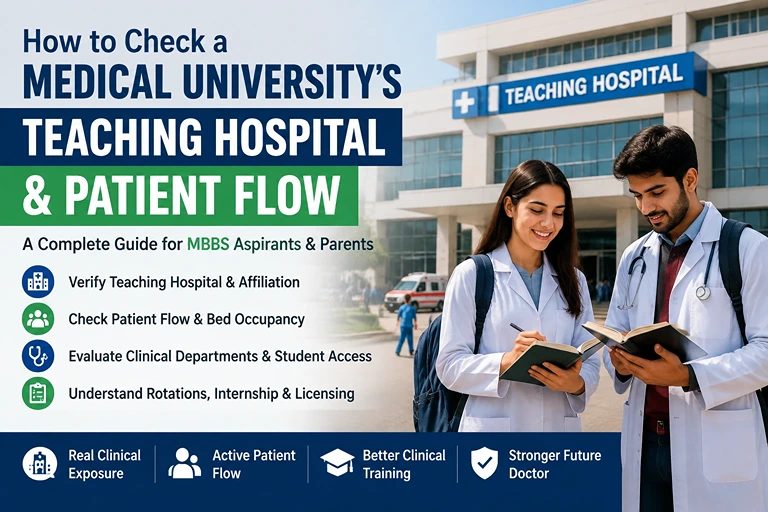
Before paying admission fees, students should verify:
- Whether the hospital is owned by the university or officially affiliated
- Whether the hospital has genuine patient activity
- Whether students get access to clinical departments
- Whether clinical rotations are properly planned
- Whether internship and licensing requirements are clear
A university’s campus can show its infrastructure, but the teaching hospital shows its medical training quality.
Why Teaching Hospital Quality Matters for MBBS Students
Medical education requires both academic knowledge and practical experience.
Students learn medical concepts in classrooms, but hospitals teach them how to apply that knowledge.
Clinical exposure helps MBBS students understand:
- How to communicate with patients
- How to take medical history
- How to perform examinations
- How doctors diagnose diseases
- How treatment decisions are made
- How emergency situations are managed
A strong teaching hospital allows students to observe different medical conditions and understand how healthcare works in real situations.
For Indian students studying MBBS abroad, hospital exposure becomes even more important because they must adapt to a different healthcare system, patient population and language environment.
Verify Whether the University Has a Genuine Teaching Hospital
Hospital Ownership vs Hospital Affiliation
The first step is understanding how the university provides clinical training.
Some universities operate their own teaching hospitals, while others have agreements with external hospitals.
Both models can work, but students must verify whether the arrangement is genuine.
A university should clearly explain:
- Which hospital is used for MBBS training
- Whether students attend that hospital regularly
- Which years receive clinical postings
- Whether international students receive equal access
Parents should request official documents instead of depending only on website information or counselling presentations.
A hospital partnership is valuable only when students actually participate in clinical learning.
How to Evaluate Hospital Patient Flow
Look at Real Activity, Not Just Hospital Claims
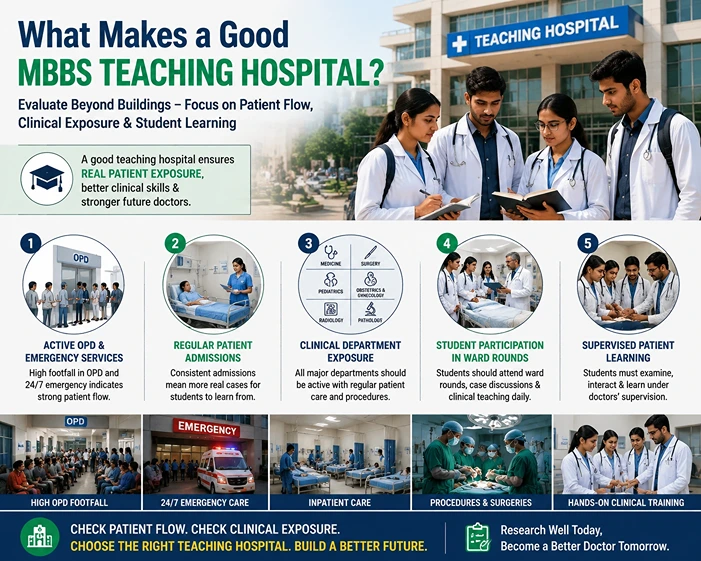
Teaching hospital patient flow is one of the most important indicators of clinical exposure.
A hospital becomes useful for MBBS students when patients regularly visit for:
- Outpatient consultations
- Emergency treatment
- Inpatient care
- Surgeries
- Specialty services
Students should understand that hospital size and hospital activity are different things.
A large hospital building does not automatically mean students will see enough cases.
The important questions are:
- Are outpatient departments active?
- Are emergency services functioning regularly?
- Are wards occupied?
- Are students involved in patient discussions?
- Are doctors conducting teaching rounds?
Bed Capacity vs Actual Hospital Usage
Many universities highlight their hospital bed count during admission campaigns.
However, bed capacity only indicates how many patients a hospital can accommodate. It does not show whether those beds are occupied or whether students receive practical exposure.
Students should look at:
- Actual patient occupancy
- Daily admissions
- Department workload
- Student access during postings
A hospital with fewer beds but consistent patient activity may provide better learning opportunities than a larger facility with limited patient movement.
Clinical Departments: Check Activity, Not Just Availability
A teaching hospital should have important departments required for MBBS training.
Students should verify whether departments are active and whether students receive clinical postings.
Important areas include:
- Internal Medicine for adult disease management
- General Surgery for surgical exposure
- Pediatrics for child healthcare training
- Obstetrics and Gynecology for maternal care experience
- Emergency Medicine for urgent patient management
- Radiology for diagnostic learning
- Pathology for disease investigation
- Anesthesia for surgical and critical care exposure
A department list on a university website is only the first step. The real question is whether students regularly learn inside those departments.
Student Access Matters More Than Hospital Size
A hospital can have excellent facilities, but students must have meaningful access.
Parents should understand:
- How many MBBS students join every year
- How students are divided during clinical rotations
- Whether students participate in ward rounds
- Whether doctors supervise student learning
A smaller student group may allow more interaction, while a very large batch may create competition for clinical opportunities.
The quality of exposure depends on the relationship between hospital workload and student numbers.
Language Barriers During Clinical Training Abroad
Language is an important factor that many students underestimate.
Even if classroom teaching is in English, patients may communicate in the local language.
Clinical learning depends on communication between the student and patient.
Students should understand:
- What language patients commonly speak
- Whether local language training is provided
- Whether students can take patient histories independently
- Whether translation support is available
A student who cannot communicate with patients may miss important clinical learning opportunities.
Clinical Rotations and Internship Structure
Clinical training schedules vary between universities.
Before admission, students should understand:
- When hospital postings begin
- How long clinical rotations continue
- Which departments are included
- How internship is organised
A proper clinical pathway usually moves from basic medical sciences to supervised patient care.
Students should request the official curriculum and rotation details before confirming admission.
MBBS Internship Abroad and Indian Licensing Requirements
For Indian students planning to return and practise in India, understanding regulatory requirements is essential.
The National Medical Commission (NMC) regulates medical education and registration standards in India.
Students should review the applicable requirements under the Foreign Medical Graduate Licentiate (FMGL) Regulations before selecting an overseas medical university.
Important areas to verify include:
- Course duration
- Clinical training structure
- Internship requirements
- Recognition pathway
- Eligibility for registration in India
Students should also understand the role of the National Exit Test (NExT) in the Indian medical licensing pathway.
A suitable MBBS abroad university should provide strong academic preparation along with sufficient clinical exposure to support future professional requirements.
Since regulations may change, students should confirm the latest information from official NMC sources before admission.
Simulation Training vs Real Patient Exposure
Many universities promote simulation laboratories as part of medical education.
Simulation training helps students practise:
- Basic examination skills
- Emergency procedures
- Clinical scenarios
However, simulation cannot replace real patient interaction.
Real hospital exposure teaches students:
- Patient communication
- Clinical judgement
- Disease presentation
- Decision-making under supervision
A good medical university should provide both simulation facilities and regular hospital-based learning.
Teaching Hospital Verification Checklist
| Evaluation Area | What Students Should Verify |
|---|---|
| Hospital Ownership | Confirm whether the hospital is owned by the university or connected through a valid official affiliation agreement. |
| Hospital Documents | Check whether affiliation documents, recognition details, and clinical training agreements are officially available. |
| Patient Flow | Verify OPD visits, emergency cases, inpatient admissions, and daily patient activity. |
| Bed Capacity vs Occupancy | Evaluate actual patient occupancy and hospital activity instead of depending only on advertised bed numbers. |
| Clinical Departments | Ensure major departments are functional and provide regular patient exposure for students. |
| Student Access | Confirm whether MBBS students participate in ward rounds, patient discussions, and clinical postings. |
| Internship Structure | Verify internship location, duration, eligibility criteria, and official documentation. |
Red Flags Before Selecting an MBBS Abroad University
Parents should be careful if a university:
- Focuses mainly on campus facilities but avoids hospital details
- Cannot provide hospital affiliation proof
- Gives unclear answers about patient exposure
- Does not explain clinical rotation schedules
- Cannot provide internship information
- Avoids connecting applicants with current students
A transparent university should be able to explain its hospital training system clearly.
MBBS Clinical Exposure Comparison Framework
| Evaluation Area | University A | University B |
|---|---|---|
| Teaching Hospital Connection | Requires document verification before admission | Official hospital affiliation confirmed with documentation |
| Patient Exposure | Limited patient activity details available | Patient flow and hospital activity information available |
| Clinical Rotations | Rotation schedule details are unclear | Structured clinical rotation plan provided |
| Student-to-Patient Access | Requires further verification | Explained through university information and current student feedback |
| Internship Details | Internship structure requires confirmation | Internship duration, location, and process documented |
| Licensing Preparation | Available information is limited | Licensing requirements and preparation pathway clearly explained |
This framework helps parents compare universities based on clinical training rather than only rankings or marketing.
Frequently Asked Questions
Students should verify the teaching hospital connection, patient flow, clinical departments, rotation schedule, internship details and official documents before paying fees.
Not necessarily. The quality of training depends on patient activity, student access, department functioning and supervision.
Patient flow determines how many real medical cases students can observe during clinical training.
Students should review university recognition, NMC requirements, FMGL Regulations and future licensing requirements.
No. Simulation supports learning, but real patient interaction is necessary for developing clinical skills.
Choosing an MBBS abroad university is a long-term career decision. The right university is not simply the one offering admission; it is the one providing the clinical environment needed to become a capable doctor.
Before making a final decision, students and parents should verify:
- Genuine teaching hospital access
- Patient exposure opportunities
- Active clinical departments
- Student rotation structure
- Internship details
- Indian licensing requirements
A careful evaluation before admission can prevent problems during medical training and help students choose a university that supports their future goals.
Help Abroad Consultancy helps Indian students and parents compare MBBS abroad universities by evaluating:
- Teaching hospital access
- MBBS clinical exposure
- Internship structure
- University documentation
- Available study options
Students and parents can request a free 1-on-1 counselling session or connect with Help Abroad Consultancy through WhatsApp to compare suitable MBBS universities and receive personalised guidance before admission.
Choose the Right MBBS University Before Admission
Verify hospital quality, patient exposure, clinical training, and internship opportunities before making your decision.