

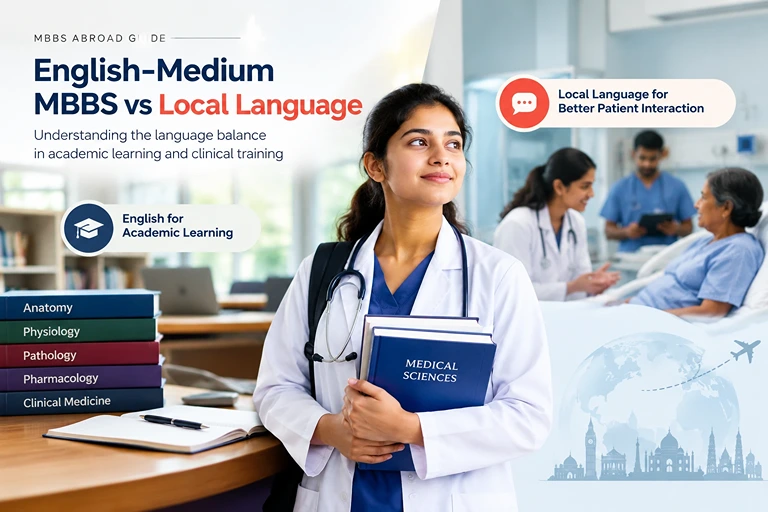
Choosing an MBBS abroad university involves understanding more than admission criteria and fees. One important factor students and parents often consider is the language environment during medical education and hospital training.
The topic of English-medium MBBS vs local language is important because many international medical programs use English for academic learning, while patient interactions during clinical rotations may involve the local language.
For Indian students planning MBBS abroad, the right approach is to evaluate both the teaching language and the communication environment in hospitals. English supports medical learning, while practical local-language skills can support better patient interaction during clinical training.
Difference Between Academic Language and Clinical Language
Medical education has two different communication settings: academic learning and clinical practice.
During academic learning, students study subjects such as anatomy, physiology, pathology, pharmacology, and clinical medicine. Many international medical programs use English as the medium of instruction because medical books, research materials, and academic resources are widely available in English.
During MBBS abroad clinical rotations, students interact with patients, doctors, nurses, and hospital staff. The language used in these interactions may depend on the country, university, teaching hospital, and patient population.
For example, some universities may conduct classroom teaching in English but require students to communicate with patients in the local language during hospital exposure. Other institutions may have more English-speaking patient environments.
Students should confirm these details directly with the university before making a decision.
Benefits of English-Medium Medical Education
Many students prefer English-medium MBBS abroad programs because English helps them access medical education resources and communicate in international academic settings.
Access to Medical Resources
Most widely used medical textbooks, journals, and research materials are available in English. Strong English skills can help students understand these resources more easily.
Better Understanding of Medical Terminology
Medical terms are commonly taught in English in many international programs. This helps students follow lectures, academic discussions, and professional communication.
Support for Future Academic Goals
Students who plan to continue medical education, research, or licensing preparation often use English-based study materials.
However, licensing requirements and eligibility rules may change over time. Students should always check the latest information from the relevant official authorities before planning their future pathway.

Importance of Local Language During Clinical Training
Learning the local language can become valuable when students move from classrooms to hospitals.
The importance of local language during clinical training depends on factors such as:
- The country where the university is located
- The teaching hospital environment
- The language commonly spoken by patients
- The level of patient interaction provided to international students
Better Patient Communication
Patient communication for medical students is an important part of clinical learning. Doctors need to understand symptoms, medical history, and patient concerns accurately.
Patients may explain their health problems using everyday words rather than medical terms. Basic knowledge of the local language can help students understand these conversations better.
Building Patient Confidence
Patients may feel more comfortable when healthcare providers communicate in a language they understand.
Simple communication skills, such as asking about symptoms, pain, medication history, and previous health problems, can improve student confidence during hospital visits.
Learning the Local Healthcare Environment
Language also helps students understand local healthcare practices, communication styles, and interactions between doctors and patients.
Is Local Language Compulsory for MBBS Abroad?
Local language requirements vary by country, university, teaching hospital, and patient population.
Some universities may provide local-language classes before or during clinical training. Others may expect students to develop basic communication skills independently.
Students should not assume that every MBBS abroad program follows the same language system.
Before admission, students should confirm:
- The official medium of instruction
- The language used during examinations
- The language commonly used during hospital rotations
- Availability of local-language classes
- When language classes begin
- The level of direct patient interaction
- Support available for international students during clinical training
Understanding these factors can help students choose a university that matches their learning needs.
How Much Local Language Should a Student Learn?
Students usually do not need complete fluency in the local language to begin clinical training. The required level depends on the university and hospital environment.
A practical focus should be on communication skills useful in healthcare settings.
Students can learn:
- Common symptoms and complaints
- Body parts and medical terms used in daily conversations
- Questions for patient history-taking
- Emergency phrases
- Basic instructions used in hospitals
The goal is not perfect language ability but the confidence to communicate effectively with patients and healthcare teams.
English vs Local Language: Which Is More Important?
English and local language support different parts of medical education.
| Area | English | Local Language |
|---|---|---|
| Understanding textbooks and research | Very important | Less important |
| Medical terminology | Important | Useful for patient explanations |
| Academic discussions | Commonly used | Depends on the location |
| Patient communication | May have limitations | Often valuable |
| Clinical confidence | Supports academic learning | Supports patient interaction |
The best approach is to develop strong English skills for medical studies while learning practical local-language communication for clinical exposure.
Language Mistakes Students Should Avoid
Students preparing for MBBS abroad should consider language planning early.
Assuming English Will Always Be Enough
Even in English-medium programs, patient communication may happen in another language depending on the hospital setting.
Ignoring Language Before Clinical Rotations
Waiting until hospital training begins may make patient interactions more challenging.
Learning Only Medical Vocabulary
Knowing medical terms is useful, but students also need everyday communication skills for patient conversations.
Not Checking University Information
Language expectations can differ between universities. Students should verify details directly instead of relying only on general advice.
Preparing for Language Needs Before Clinical Rotations
Students can take practical steps before entering hospitals.
Create a Medical Language Glossary
Prepare a personal list of:
- Common symptoms
- Body parts
- Patient-history questions
- Emergency expressions
Reviewing these regularly can improve confidence.
Practise Patient History Conversations
Students can practise asking basic questions related to:
- Pain location
- Duration of symptoms
- Previous treatment
- Medication use
- Allergies
Learn From Local Students
Speaking with local classmates can help international students understand commonly used phrases and communication styles.
Take Feedback From Mentors
Doctors, seniors, and clinical supervisors can provide guidance on improving patient communication skills.
Questions to Ask Before Selecting an MBBS Abroad University
Before choosing a university, students should ask specific questions about the language environment:
- What is the official medium of instruction?
- In which language are examinations conducted?
- What language is commonly used during hospital rotations?
- Does the university provide local-language classes?
- When do language classes begin?
- How much direct patient interaction is available?
- How are international students supported during clinical training?
These questions help students understand the real learning environment before admission.
How Help Abroad Consultancy Helps Students Choose the Right University
Choosing an MBBS abroad university requires comparing multiple factors, not just the course fee or location.
Help Abroad Consultancy helps families compare universities based on:
- Medium of instruction
- Clinical exposure opportunities
- Hospital communication environment
- Local-language support
- Budget planning
- Eligibility requirements
- Current applicable regulations
A careful evaluation of academic language and clinical communication requirements can help students select a university that suits their goals.
Planning to study MBBS abroad? Talk to Help Abroad Consultancy to compare universities based on academic language, clinical exposure, local-language requirements, budget, eligibility, and current regulations.
Frequently Asked Questions
English may be sufficient for academic learning in many international medical programs. However, students may need practical local-language skills depending on their clinical training environment.
Not always. Requirements vary by country, university, hospital, and patient population. Students should confirm specific requirements before admission.
Students should focus on practical communication skills for patient interaction, including symptoms, medical history questions, and basic hospital conversations.
Yes. Difficulty communicating with patients can affect history-taking and confidence during clinical rotations. Basic language preparation can help students participate more effectively.
Students should ask about the teaching language, examination language, hospital rotation language, availability of language support, and level of patient exposure.
The choice between English-medium MBBS vs local language is not about selecting one language over another. Both have different roles in medical education.
English helps students understand medical concepts, access academic resources, and participate in professional discussions. Local-language skills can support patient communication and improve confidence during clinical training.
Before selecting an MBBS abroad university, students and parents should evaluate the medium of instruction, hospital communication environment, clinical exposure opportunities, and available language support. Making an informed decision can help students prepare better for both medical studies and patient care.
Choose an MBBS University With the Right Language and Clinical Environment
An English-medium course alone does not guarantee a smooth clinical experience. Understand the teaching language, hospital environment, patient interaction, local-language support, eligibility requirements, and total budget before choosing a university.
Get Expert MBBS Guidance