
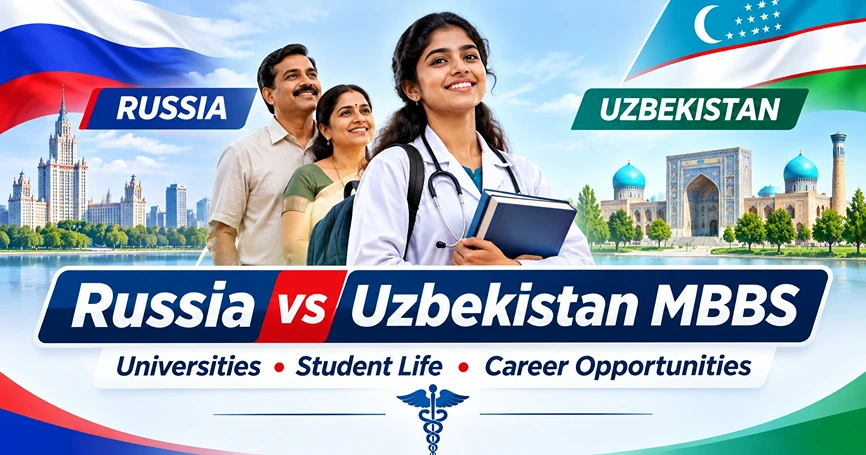
Choosing between Russia and Uzbekistan for medical studies is an important decision for Indian students planning to become doctors. The Russia vs Uzbekistan MBBS comparison involves much more than selecting a country or university. Students need to consider teaching quality, clinical experience, NMC guidelines, student support and future career opportunities.
Both countries have medical universities that attract international students. However, the learning environment, language requirements, campus facilities and practical training arrangements can differ between institutions.
For students from Kerala, adjusting to a new culture, climate and education system is also an important part of studying abroad.
This guide compares MBBS in Russia and Uzbekistan to help students and parents make a well-informed decision.
Russia vs Uzbekistan MBBS: Which Is Better for Indian Students?
Neither country is automatically the best choice. The right medical university depends on academic quality, clinical training, student welfare and regulatory compliance.
Russia has an established medical education system with universities offering General Medicine programmes to international applicants. Students can find institutions with teaching hospitals, research opportunities and international student communities.
Uzbekistan also has medical universities offering programmes for international students. Its cities, educational institutions and regional culture provide a different student experience.
The most important difference may not be the country itself, but the university and programme selected.
Students should compare the exact institution, campus, teaching language, hospital access and documentation before accepting admission.
MBBS in Russia vs Uzbekistan: Quick Comparison
| Comparison Factor | Russia | Uzbekistan |
|---|---|---|
| Medical Education | Established university system | Established medical institutions serving local and international students |
| English-Medium Education | Available in selected programmes | Available in selected programmes |
| Clinical Training | Depends on university and hospital arrangements | Depends on university and hospital arrangements |
| Local Communication | Russian is important | Uzbek and Russian may be important |
| Climate | Cold winters, varying by region | Cold winters and hot summers in many cities |
| Indian Student Community | Present at various universities | Present at various universities |
| Food and Accommodation | Depends on campus and city | Depends on campus and city |
| Cultural Experience | Russian and international campus environment | Central Asian culture and regional traditions |
| NMC Compliance | Must be checked for the selected programme | Must be checked, including relevant NMC advisories |
| Career Pathway in India | Subject to applicable Indian rules | Subject to applicable Indian rules |
Medical Universities in Russia and Uzbekistan
Choose a university based on verified academic and clinical facilities, not promotional rankings or popularity alone.
Medical universities in Russia
Some universities that Indian students may research include:
Saratov State Medical University
Saratov State Medical University is an established medical institution offering medical education and related academic programmes. Applicants should check its current international admissions information and the teaching language of their intended programme.
Dagestan State Medical University
Dagestan State Medical University offers medical education in several fields. Students should confirm the instruction language, clinical learning arrangements and the exact campus of study.
Kazan State Medical University
Kazan State Medical University is another Russian institution that prospective medical students may consider researching. It is important to verify the specific programme’s curriculum and arrangements for international students.
Medical universities in Uzbekistan
Samarkand State Medical University
Samarkand State Medical University offers medical education to domestic and international students. However, the institution is named in the NMC’s April 2026 Uzbekistan advisory. Indian applicants should obtain clear written answers about their intended programme and any issues raised by regulators.
Tashkent State Medical University
Tashkent State Medical University is also named in the advisory, including concerns relating to certain educational arrangements. Students should confirm the exact institution and location where their education and clinical learning would take place.
Bukhara State Medical Institute
Bukhara State Medical Institute is another institution mentioned in the advisory. Applicants should verify current programme information and seek official clarification about its suitability for their intended career pathway.
Andijan State Medical Institute
Andijan State Medical Institute offers medical education and has published information for international applicants. Students should examine its current official programme documents and hospital training arrangements before applying.
Students exploring medical education in Uzbekistan can also read our guide to affordable MBBS options in Uzbekistan to understand what to consider when comparing universities, admission requirements and student facilities.
Important: The presence of a university in an international directory does not automatically establish that every programme satisfies Indian medical registration requirements.
Quality of Medical Education and Clinical Training
Medical education should prepare students for patient care, not only academic examinations.
Medical students need to develop scientific knowledge alongside practical clinical skills.
Both Russia and Uzbekistan have universities with classroom teaching, laboratories and hospital-based education. However, the facilities and opportunities available to international students can vary.
Classroom learning
Students should review how their university teaches essential subjects such as anatomy, physiology, pathology, pharmacology and clinical medicine.
Useful questions include whether the university provides modern laboratories, qualified teaching staff, academic mentoring and accessible learning resources.
Clinical exposure
Clinical training introduces students to patient assessment, medical communication, diagnosis and supervised care.
Before choosing a university, students should find out which hospitals provide training and how international students participate in supervised clinical activities.
An institution’s claim to have a teaching hospital is only a starting point. Students should confirm the practical opportunities actually available.
Language during hospital training
An English-medium academic programme may still involve patient interactions in Russian or Uzbek.
Students should ask how the university prepares international learners to communicate with local patients.
Learning the local language is valuable for both clinical confidence and everyday life.
NMC Guidelines for MBBS in Russia and Uzbekistan
Admission to a foreign medical university does not automatically guarantee eligibility to practise medicine in India.
The National Medical Commission regulates the applicable requirements for foreign medical graduates who wish to pursue medical registration in India.
Indian students should read the official Foreign Medical Graduate Licentiate Regulations, relevant clarifications and newer advisories before choosing a university.
Among the matters requiring verification are:
- The medical qualification awarded.
- The actual medium of instruction.
- Required subjects and practical training.
- Clinical education and internship arrangements.
- Professional registration or licensing eligibility in the country awarding the qualification.
- Applicable Indian screening, licensing and registration requirements.
Important NMC advisory concerning Uzbekistan
On 1 April 2026, the NMC issued an advisory concerning undergraduate medical admissions in Uzbekistan. It raised concerns involving certain medical institutions and educational arrangements, including clinical training and regulatory compliance.
The advisory names Samarkand State Medical University, Tashkent State Medical University and Bukhara State Medical Institute, among other relevant arrangements.
Students should read the complete advisory and request institution-specific clarification. It should not be interpreted as a blanket judgment on every programme in Uzbekistan.
The NMC also published an advisory in November 2026 encouraging students and parents to verify the authenticity and regulatory approval of medical institutions before making admission decisions.
The same careful approach should apply to Russian medical universities.
Official references: NMC Rules and Regulations and NMC News and Advisories.
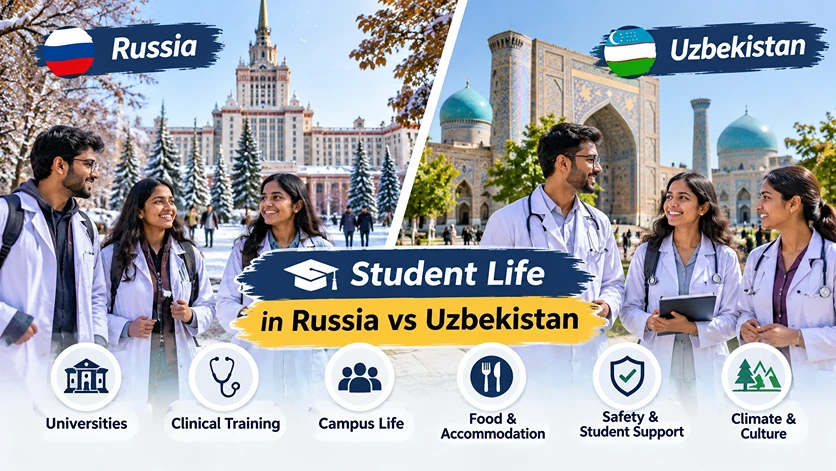
Student Life in Russia vs Uzbekistan
A supportive hostel, accessible food, student safety and a welcoming campus are important to academic success abroad.
For many Kerala students, moving overseas may be their first experience living away from family.
Student life can influence confidence, health and academic performance.
Student life in Russia
Russian university cities can offer multicultural student communities, public transport, libraries, recreational facilities and opportunities to experience local traditions.
International students may also take part in cultural events and student organisations, depending on their institution.
Winter can be challenging for newcomers from Kerala. Appropriate clothing, safe transport and well-maintained accommodation become particularly important.
Student life in Uzbekistan
Uzbekistan offers a Central Asian cultural environment with historical cities, local markets and established educational centres.
International students may experience local cultural festivals, traditional food and interaction with students from different countries.
Daily life varies between cities such as Tashkent, Samarkand, Bukhara and Andijan.
Parents should confirm whether the selected institution offers reliable accommodation, emergency contacts and appropriate student support.
Food and accommodation for Kerala students
Many students from Kerala prefer having access to familiar foods, including rice, vegetarian meals and Indian groceries.
Availability differs by city, hostel and university. Students should also check kitchen access, food hygiene, hostel rules and nearby shopping facilities.
Speaking to current students from Kerala can provide useful practical information, but personal experiences should be checked against official accommodation policies.
Climate and Cultural Differences
Climate and cultural adjustment depend on the city and the individual student, not simply the country.
Russia and Uzbekistan have different geographical and cultural characteristics.
Climate in Russia
Many Russian regions experience cold winters, with temperatures and seasonal conditions varying significantly across the country.
Students from Kerala should prepare for unfamiliar weather, appropriate winter clothing and changes to their daily routines.
Climate in Uzbekistan
Uzbekistan has a largely continental climate. Many areas experience hot summers and cold winters.
Although conditions may feel different from Russia, students should not assume every Uzbek city has mild winters.
Cultural adjustment
Students in both countries can benefit from learning basic local-language phrases, understanding social customs and respecting local laws.
Regular communication with family, participation in campus activities and access to dependable student support can make the transition easier.
Safety and Student Support
Verify campus-specific security and emergency arrangements rather than relying on general claims that an entire country is safe.
Safety should be a priority for students and parents.
Before choosing a university, confirm:
- Hostel security and accommodation rules.
- Availability of university emergency contacts.
- Access to healthcare and insurance.
- Local transportation options.
- Student grievance and welfare services.
- The institution’s support for international students.
- Relevant travel advisories from Indian authorities.
International travel conditions, payment services and regional security situations can change.
Families should review the latest guidance from the Ministry of External Affairs, India and the appropriate Indian embassy before travelling.
Career Opportunities After MBBS in Russia or Uzbekistan
Career opportunities depend on professional eligibility, clinical competence and the requirements of the country where a graduate wishes to practise.
Students studying medicine abroad may wish to return to India, pursue further medical education or explore other professional opportunities.
Returning to India
Foreign medical graduates must follow the applicable NMC and medical registration processes.
Students should monitor official information about screening or licensing examinations, registration documents and clinical training obligations.
They should not assume that graduating from a particular foreign university guarantees permission to practise in India.
Postgraduate medical education
Graduates interested in postgraduate education must meet the admission and licensing requirements of the relevant destination.
Eligibility may differ between India, Russia, Uzbekistan and other countries.
Building clinical confidence
Whichever country a student chooses, strong subject knowledge, supervised patient exposure, communication skills and professional ethics remain essential.
Students should take academic and clinical preparation seriously throughout their education.
Common Mistakes Indian Students Should Avoid
Missing or unverifiable information about a programme is a reason to investigate further before accepting admission.
Myth vs Fact
| Myth | Fact |
|---|---|
| Every international medical university follows the same standards | Requirements and academic arrangements vary between institutions |
| English-medium teaching means no local language is needed | Local language skills may be important during patient care |
| A foreign medical degree guarantees medical registration in India | Graduates must meet applicable Indian regulations |
| Popular universities are always the best choice | Students should examine the exact programme and clinical facilities |
| A consultancy's recommendation replaces university verification | Official documents and regulatory requirements must be checked independently |
How Kerala Students Can Choose the Right MBBS University
A document-based university comparison is more reliable than choosing from photographs, testimonials or promotional rankings.
Consider an illustrative situation involving two students from Kochi.
One is attracted to a Russian university because of its international student community and campus facilities. The other prefers a university in Uzbekistan because of its cultural environment and student accommodation.
Instead of choosing immediately, both students request official academic details.
They compare teaching languages, clinical facilities, university support, accommodation arrangements and the medical qualification awarded.
They also check the latest NMC regulations and any advisories relevant to their selected institutions.
This process helps them identify which questions remain unanswered.
MBBS Abroad Checklist for Indian Students and Parents
Collect and verify primary documents before making an overseas medical education decision.
Before choosing a university
- Confirm NEET eligibility under current rules.
- Read applicable NMC regulations and advisories.
- Verify the institution’s official website and campus.
- Request the complete programme and clinical training documents.
- Confirm teaching and hospital communication languages.
- Contact current students from the same institution.
- Evaluate accommodation, welfare and safety arrangements.
Proof to retain: University correspondence, academic documents, official website links and verification dates.
Before travelling abroad
- Confirm admission documents directly with the institution.
- Check passport and visa requirements.
- Arrange suitable accommodation.
- Verify health insurance and emergency medical support.
- Review official travel advisories.
- Save important documents securely.
- Share verified university and emergency contact details with family.
Proof to retain: Admission documents, travel documents, insurance details and emergency contacts.
Frequently Asked Questions About Russia vs Uzbekistan MBBS
Neither country is automatically better for every student. The choice depends on the university’s academic quality, clinical training, language environment, student support and regulatory suitability.
Russia has medical universities with programmes for international students. However, students should independently verify the chosen institution, its current teaching arrangements and its suitability under applicable Indian regulations.
Uzbekistan has institutions offering medical education to international students. Indian applicants must pay close attention to the NMC’s April 2026 advisory and obtain reliable documentation about the specific university and programme.
Indian applicants covered by the relevant foreign medical education requirements must satisfy NEET eligibility rules. Admission by a foreign university does not remove obligations under Indian regulations.
Selected universities offer English-medium programmes. Students should verify the actual teaching language, assessments and clinical communication requirements directly with their institution.
The experience depends on the university, location, hostel and student’s preferences. Campus support, language, climate, food and local transportation can all affect adjustment.
Parents should examine official academic documents, clinical facilities, student welfare policies and applicable Indian regulatory requirements. Speaking with existing students can provide additional insight but should not replace independent verification.
The Russia vs Uzbekistan MBBS decision requires careful consideration of medical education quality, hospital training, language, student welfare and future professional eligibility.
Russia offers a range of medical universities and international student experiences. Uzbekistan also offers medical education opportunities, although Indian applicants should carefully review the recent NMC advisories concerning specific institutions.
For Kerala students and parents, the right approach is to compare actual university programmes, ask clear questions and verify information through official sources.
Students seeking assistance with university research and application documentation can contact Help Abroad Consultancy for guidance while independently confirming academic and regulatory requirements.
The best choice is a medical university where students can develop the knowledge, clinical skills and professional foundation needed for their future careers.
Confused Between MBBS in Russia and Uzbekistan? Let Us Guide You!
Choosing the right medical university is an important step toward your dream of becoming a doctor. Help Abroad Consultancy helps Kerala and Indian students explore medical universities, understand admission requirements, and make informed study abroad decisions.
Get expert guidance for your MBBS abroad journey today!
Contact Help Abroad Consultancy →