
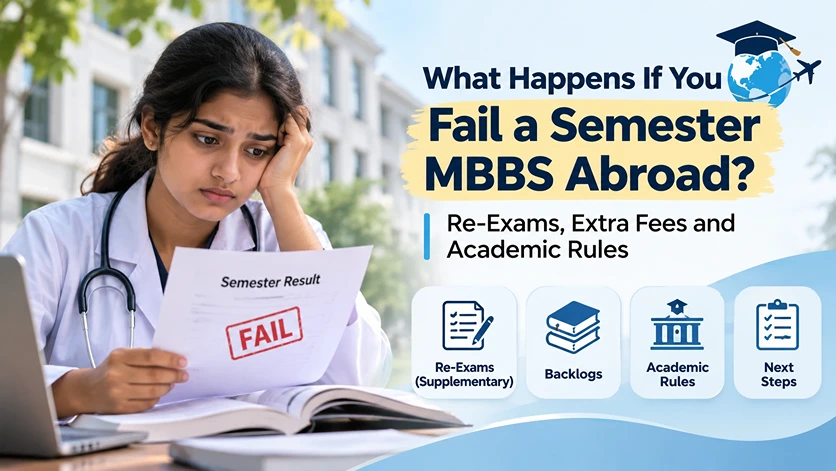
Failing a semester while studying MBBS abroad can be stressful, especially for Indian students adjusting to a different education system. But if you fail a semester MBBS abroad, it does not automatically mean your medical career is over.
Depending on your university’s academic rules, you may be eligible for supplementary examinations, allowed to clear pending subjects, or required to repeat certain academic components.
For students from Kerala studying medicine in countries such as Georgia, Russia, Kazakhstan, and Uzbekistan, understanding these rules is important. Every university has its own examination policies, passing requirements, and procedures for handling unsuccessful results.
This article explains what happens when an MBBS student fails a semester abroad, how re-exams and backlogs work, and what Indian students should know about university regulations and future medical registration in India.
What Happens If You Fail a Semester MBBS Abroad?
Failing a semester abroad does not always mean failing the entire medical programme. The consequences depend on the university’s examination system and the student’s academic performance.
A student who fails one subject may face different requirements from someone who fails several compulsory subjects.
Universities may offer the following academic options.
Supplementary examinations
Some universities allow eligible students to take supplementary examinations, commonly called re-exams or resits.
These assessments provide another opportunity to pass a failed subject.
If the student successfully completes the required examination and meets the university’s promotion conditions, they may be allowed to continue with their studies.
Academic backlogs
A backlog refers to a subject or academic requirement that has not been successfully completed.
Some universities permit students to continue studying while clearing pending subjects. Others require compulsory subjects to be passed before promotion.
Repeating academic requirements
When students do not meet the required passing standards, the university may ask them to repeat a subject, complete additional coursework, or take further assessments.
The exact procedure depends on the programme’s academic regulations.
Academic discontinuation
Universities may have rules concerning repeated failures or exceeding the permitted examination attempts.
In serious cases, these regulations may lead to academic discontinuation.
However, failing one examination does not automatically result in removal from the medical programme.
The best approach is to check the university’s official academic handbook before assuming the consequences of an unsuccessful examination.
Can You Take Re-Exams After Failing MBBS Abroad?
Many overseas medical universities offer supplementary examinations for eligible students. However, re-examination policies are not identical across institutions.
A supplementary examination is an opportunity to demonstrate that the student has achieved the required academic standard after an unsuccessful assessment.
How do supplementary examinations work?
Depending on university rules, students may need to:
- Review their official examination results.
- Confirm eligibility for a supplementary examination.
- Register through the university’s examination department.
- Complete any required academic support activities.
- Take the supplementary examination.
- Obtain official confirmation of the result.
The process may differ for theoretical subjects, laboratory assessments, and clinical examinations.
Are re-exams guaranteed?
No. Some universities permit supplementary examinations under specified conditions, while others apply different reassessment rules.
Students should not assume that every failed subject automatically qualifies for another attempt.
What if you fail a supplementary examination?
The university may require additional academic work, repetition of the relevant subject, or another permitted form of reassessment.
Repeated unsuccessful assessments may also affect academic progression.
Students should obtain written clarification from the university’s academic department about their available options.
Can You Continue MBBS Abroad With a Backlog?
Whether an MBBS student can continue with a backlog depends on the university’s academic progression rules.
Some universities may permit students to proceed with pending subjects under certain conditions.
Other institutions require students to clear specified compulsory subjects before progressing.
What is a backlog in MBBS?
A backlog is an academic subject or assessment that a student has not successfully completed.
For example, a student may pass most examinations but fail one compulsory medical subject.
The university then decides whether the student can continue with other academic activities while completing the outstanding requirement.
Why do some subjects prevent academic progression?
Medical education includes subjects that provide essential knowledge for more advanced learning.
Certain courses may be prerequisites, meaning students must complete them before studying related advanced subjects or beginning particular clinical activities.
Therefore, an unsuccessful result in a compulsory subject may affect a student’s eligibility for academic promotion.
What should students check?
Before making assumptions, students should confirm:
- Whether backlogs are permitted.
- Which compulsory subjects must be cleared.
- Whether supplementary examinations are available.
- How failed practical assessments are handled.
- What academic support the university provides.
The university’s official regulations should always guide these decisions.
Do MBBS Failure Rules Differ Between Countries?
Yes. Examination and academic progression policies may differ between medical universities, even within the same country.
Students considering MBBS abroad should avoid assuming that all institutions in a particular destination follow identical rules.
MBBS examination rules in Georgia
Medical universities in Georgia may have institution-specific policies concerning assessment, academic credits, failed subjects, and progression.
Students should consult the official academic handbook of their chosen institution.
MBBS examination rules in Russia
Medical universities in Russia may apply their own regulations for academic arrears, reassessments, and student progression.
Students should request clear information directly from the university about how unsuccessful examinations are handled.
MBBS examination rules in Kazakhstan
Students considering Kazakhstan should check their university’s passing requirements, backlog policies, supplementary examination procedures, and promotion conditions.
MBBS examination rules in Uzbekistan
Medical universities in Uzbekistan may have specific requirements for written examinations, practical assessments, attendance, and completing compulsory coursework.
Students should verify these rules with their chosen university rather than relying on general claims about examination difficulty.
What should Indian students compare?
| Academic Factor | What Students Should Verify |
|---|---|
| Passing requirements | Minimum academic standards for each subject |
| Supplementary examinations | Whether reassessments are permitted |
| Backlog policies | Whether students can progress with pending subjects |
| Academic promotion | Requirements for entering the next academic stage |
| Clinical examinations | Procedures for unsuccessful practical assessments |
| Academic support | Availability of remedial teaching and faculty guidance |
| Repeated failure | Consequences under university regulations |
Comparing these policies helps students make informed decisions about overseas medical education.
Can Failing MBBS Abroad Affect NMC Eligibility in India?
One of the biggest concerns for Indian students is whether failing an overseas medical examination can affect their future eligibility to practise medicine in India.
An individual failed university examination does not automatically disqualify a student from future medical registration in India.
However, students must successfully complete their foreign medical qualification and satisfy the applicable National Medical Commission (NMC) regulations.
Understanding university and NMC requirements
The overseas university determines whether a student has passed the required examinations and completed its medical programme.
The National Medical Commission regulates the requirements relevant to foreign medical graduates seeking registration in India.
These are separate processes.
A university may permit a student to clear pending academic requirements, but that permission alone does not establish future registration eligibility in India.
What should Indian students verify?
Students should check whether their foreign medical education satisfies the applicable requirements concerning:
- The required medical subjects and curriculum.
- English-medium instruction.
- Practical and clinical training.
- Internship arrangements.
- Eligibility for medical registration in the country awarding the qualification, where applicable.
- Indian internship and screening or licensing requirements.
The precise requirements depend on the regulations applicable to the student, including admission-batch provisions and official clarifications.
Students can refer to the National Medical Commission’s official regulations for authoritative information.
Will failing a semester affect FMGE eligibility?
The Foreign Medical Graduate Examination (FMGE) is an examination associated with the Indian registration pathway for eligible foreign medical graduates.
Failing an examination at an overseas university is not the same as failing the FMGE.
Students must complete their foreign medical qualification and satisfy the applicable eligibility requirements before applying for the relevant Indian examination.
Professional review advised: Students facing unusual academic situations, university transfers, or interrupted clinical training should obtain written clarification from the appropriate academic and regulatory authorities.
Can You Change Universities After Failing MBBS Abroad?
Some students consider transferring to another medical university after facing examination difficulties.
However, university transfers should be approached carefully.
A receiving university may accept previously completed subjects, but this does not automatically establish that the resulting foreign medical qualification meets Indian registration requirements.
What should students check before transferring?
Students should confirm:
- Whether the receiving university recognises their previous academic work.
- Whether failed subjects must be completed again.
- Whether the transfer is permitted under both institutions’ academic regulations.
- Whether the curriculum and clinical training arrangements remain appropriate.
- Whether the transfer is compatible with the NMC requirements applicable to the student.
Students should not depend on verbal promises that transferring to another university will automatically clear academic backlogs.
Written confirmation from the relevant institutions and authorities is essential before making a decision.
Common Mistakes Students Make After Failing MBBS Abroad
An unsuccessful examination can be disappointing, but making decisions without checking official regulations may create further complications.
Assuming one failed subject means the medical programme is over
One unsuccessful examination does not automatically lead to academic discontinuation.
Students should first confirm whether supplementary examinations or other recovery options are available.
Ignoring official university notices
Universities may communicate important academic decisions through student portals, official emails, or examination departments.
Students should carefully follow these communications.
Relying only on classmates or admission representatives
Other students may have different academic circumstances or may have joined under different regulations.
Always verify information with authorised university staff.
Neglecting practical and clinical requirements
Medical education involves more than written examinations.
Students must also satisfy the programme’s practical, clinical, and attendance requirements.
Ignoring the reason for examination failure
Academic difficulties may arise from ineffective study methods, difficulty understanding medical concepts, unfamiliar examination formats, or challenges with practical assessments.
Identifying the cause is an important part of academic recovery.
Considering a university transfer without regulatory checks
A transfer can raise questions about curriculum recognition, academic continuity, and future registration eligibility.
Students should obtain appropriate written guidance before proceeding.
Avoiding communication with parents
Some students hesitate to share unsuccessful examination results with their families.
However, clear communication can help students and parents understand the academic options and make informed decisions.
For Kerala families, maintaining contact with the student and the university’s academic department can be particularly helpful.
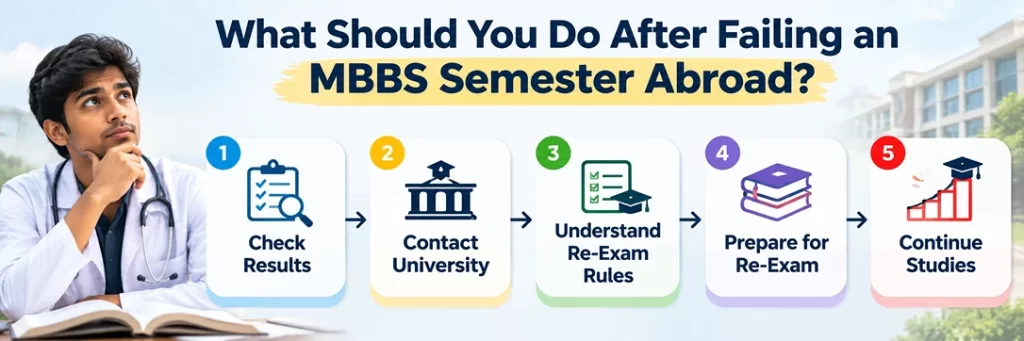
What Should You Do After Failing an MBBS Semester Abroad?
If you receive an unsuccessful examination result, focus on understanding your academic position and following the correct procedures.
Step 1: Review your official result
Identify which subjects or academic requirements have not been completed successfully.
Do not assume that failing a subject means failing the entire semester.
Step 2: Read the university’s academic handbook
Check the regulations covering supplementary examinations, backlogs, reassessments, and academic promotion.
Step 3: Contact the academic department
Ask the examinations office or academic adviser to explain the available recovery options.
Request written clarification when necessary.
Step 4: Understand why you failed
Review your examination performance and identify the areas that require improvement.
Seek feedback from lecturers wherever possible.
Step 5: Get academic support
Attend remedial classes if available, consult teachers, and use recommended study resources.
Step 6: Prepare for reassessment
If the university permits another examination attempt, create a structured study plan based on the areas needing improvement.
Step 7: Inform your family
Share accurate information about the examination result and the university’s official response.
Step 8: Keep proper academic records
Maintain copies of examination results, university communications, academic notices, and reassessment documents.
These records may be useful when clarifying academic progress later.
How Can Kerala Parents Choose an MBBS University With Clear Academic Rules?
For Kerala students and parents exploring overseas medical education, understanding a university’s academic regulations is an important part of choosing the right institution.
Before admission, families should ask:
- What are the passing requirements for compulsory medical subjects?
- Does the university provide supplementary examinations?
- Can students continue with academic backlogs?
- How are failed clinical assessments handled?
- What happens when students do not meet academic promotion requirements?
- Is academic support available for international students?
- Can the institution provide its official examination policies in writing?
Why academic transparency matters
Consider a hypothetical student from Kochi comparing two overseas medical universities.
The first university provides a clear handbook explaining examinations, reassessments, academic progression, and available student support.
The second institution offers general assurances about examination success but does not provide clear written policies.
The first university offers greater transparency because the student can understand its academic expectations before joining.
This does not automatically make it academically superior. It demonstrates why clear regulations are a valuable part of university selection.
Students and parents can explore more overseas medical education information through Help Abroad.
How Can Students Reduce the Risk of Failing MBBS Exams Abroad?
Medical education requires consistent study habits, active learning, and regular participation in practical training.
Students adapting to a foreign country may also need support in understanding unfamiliar teaching methods and examination formats.
The following practices can help students prepare more effectively.
Attend lectures and practical sessions
Regular attendance helps students understand the curriculum and complete compulsory academic activities.
Study consistently
Reviewing subjects throughout the semester can make difficult medical concepts easier to understand.
Ask questions when necessary
Students should seek clarification from lecturers or academic advisers when they struggle with a subject.
Use reliable learning materials
Prioritise university-approved textbooks, lecture resources, and recognised medical learning materials.
Practise examination techniques
Where permitted, use authorised practice questions and academic feedback to improve examination performance.
Seek support for difficult subjects
If a subject becomes challenging, ask whether the university offers tutorials, remedial teaching, or additional academic guidance.
Maintain healthy study habits
Adequate sleep, balanced meals, physical activity, and appropriate rest can support academic well-being.
Follow academic integrity rules
Students should complete examinations, assignments, and clinical records honestly and follow the university’s academic conduct policies.
The purpose of medical education is not simply to pass examinations, but to develop the knowledge and competence needed for responsible medical practice.
Frequently Asked Questions About Failing MBBS Abroad
You may be eligible for a supplementary examination or another reassessment opportunity. Some universities permit students to continue with pending subjects, while others require compulsory subjects to be cleared before academic promotion.
Yes, if your university permits supplementary examinations and you meet the eligibility requirements. Reassessment policies vary between institutions.
Some universities permit students to repeat subjects or complete additional academic requirements. The procedure depends on the institution’s regulations.
An unsuccessful university examination does not automatically determine FMGE eligibility. Students must complete their foreign medical qualification and meet the applicable Indian regulatory requirements.
A transfer may be academically possible, but it can raise questions about recognition of previous coursework and Indian registration eligibility. Obtain written clarification before making a transfer decision.
Potentially, yes. An unsuccessful university examination does not automatically end your medical career. You must successfully complete your foreign medical qualification and satisfy the requirements for medical registration in India.
Failing an MBBS semester abroad can be disappointing, especially for students who have worked hard to pursue medical education overseas.
However, a failed examination does not automatically mean that a student must abandon their goal of becoming a doctor.
Depending on university regulations, students may be eligible for supplementary examinations, permitted to clear academic backlogs, or required to complete additional coursework.
The most important step is to understand the specific university rules and follow official academic procedures.
Students should maintain communication with their academic departments, seek learning support, and keep proper records of their progress.
For Kerala students and parents considering MBBS abroad, reviewing examination policies before admission can help them make better-informed university choices.
It is equally important to understand that academic progression abroad and future medical registration in India are separate considerations.
Planning to Study MBBS Abroad? Make an Informed Choice!
Worried about re-exams, backlogs, or academic rules at foreign medical universities? Help Abroad helps Kerala students and parents understand their study options, university requirements, and admission process.
Get guidance to choose a medical university that fits your academic goals.
Get Expert MBBS Abroad Guidance Today →