
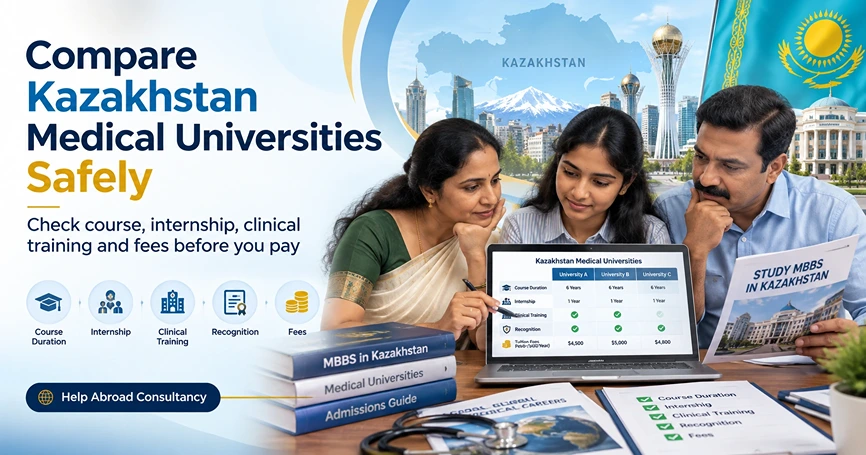
Compare medical universities in Kazakhstan before paying any admission fee, because fixing a wrong choice later can be difficult.
Choosing a medical university abroad is a major decision, especially when the student plans to return to India and practise medicine.
For Kerala students considering Kazakhstan, the comparison should go beyond tuition fees, campus photos and statements such as “internationally recognised.” Before paying an admission fee, families should check the course structure, internship, medium of instruction, clinical training, university status, local licensing eligibility and complete cost.
This matters because the National Medical Commission (NMC) does not endorse a list of foreign medical universities. NMC advises students to obtain course and fee information directly from the university before admission.
Why Comparing Universities Before Payment Matters
An admission offer is not enough; students need written proof that the programme matches the rules relevant to their future career.
The unique rule for this decision is simple: compare universities in Kazakhstan before paying an admission fee, not after.
A university may have a good campus, affordable fees and an active international admissions team. None of these automatically proves that its medical programme is suitable for an Indian student.
For students covered by the Foreign Medical Graduate Licentiate Regulations, NMC specifies requirements including a medical course of at least 54 months, a minimum 12-month internship in the same foreign medical institution, English as the medium of instruction and required medical subjects. The graduate must also meet the relevant licensing or registration conditions in the country awarding the degree.
NMC’s current regulations page continues to list the 2021 FMGL Regulations and also lists an FAQ dated June 8, 2026.
Trade-off: Taking a few extra days to verify documents may slow the admission process, but it is safer than making a large payment based mainly on verbal assurances.
How to Compare Medical Universities in Kazakhstan
A good university comparison checks seven areas: regulation, recognition, course, internship, clinical exposure, cost and student support.
Instead of comparing twenty small features, start with these seven.
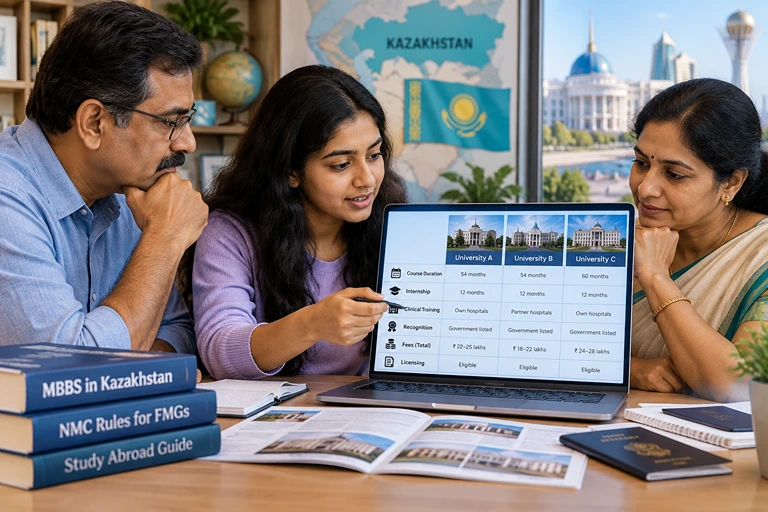
| What to compare | What you should verify | Requirement / unit | Checked |
|---|---|---|---|
| Course duration | Official curriculum and academic calendar | Minimum 54 months* | Oct 2026 |
| Internship | Duration and where it is completed | Minimum 12 months* | Oct 2026 |
| Medium | Official medium-of-instruction confirmation | English* | Oct 2026 |
| Clinical training | Hospitals, rotations and practical exposure | Programme specific | Oct 2026 |
| Recognition | University and medical school status | Official records | Oct 2026 |
| Fees | Tuition, hostel and compulsory charges | Full course cost | Oct 2026 |
| Licensing | Eligibility after graduation | Country + India requirements | Oct 2026 |
1. Check NMC Requirements, Not “NMC Approval
One common admission phrase is “NMC-approved university.” Students should be careful with that wording.
NMC states that it does not endorse a list of foreign medical institutions or universities. The important question is whether the actual medical programme meets the requirements that apply to the student.
Ask the university for its curriculum, course duration, internship structure and medium of instruction in writing.
2. Check University Recognition Separately
Recognition should not be reduced to one logo or directory listing.
Kazakhstan’s government publishes information on recognised higher-education institutions and medical institutes. Families can use those official records as part of their checks.
You can also search the medical school in the World Directory of Medical Schools. However, WDOMS clearly states that being listed does not by itself mean the school is recognised, accredited or endorsed.
Unpopular truth: WDOMS listing is a useful check, but it should never be the only reason for choosing a university.
3. Understand the Course and Internship Structure
Do not stop at the phrase “six-year medical programme.”
Ask the university to show how those years are divided between academic study, clinical training and internship.
For students covered by FMGL 2021, NMC specifies at least 54 months of medical education and at least 12 months of internship in the same foreign medical institution. NMC’s FAQ also states that the foreign medical course should be completed within ten years from joining.
The safest question to send the university is:
“Please confirm the duration of the medical course and internship separately, including where the internship is completed.”
4. Check English-Medium Teaching and Clinical Exposure
An “English-medium programme” should mean more than English brochures.
Ask whether lectures, examinations and academic teaching are conducted in English. NMC’s FMGL rules include English as the required medium of instruction for students covered by those regulations.
Clinical exposure also deserves separate attention. Ask which hospitals students attend, when clinical rotations begin, which specialties are covered and whether international students receive supervised patient exposure.
In Kazakhstan, students may also need some local-language ability for communication with patients. This does not automatically make a programme unsuitable, but families should understand the practical situation before admission.
5. Compare the Full Cost, Not Just Tuition
Two universities with similar tuition fees can have very different total costs.
Compare tuition together with hostel charges, insurance, visa or residence expenses, registration charges, examination fees, food, transport and other compulsory payments.
NMC specifically advises students to obtain the fee structure and course details directly from the foreign university or institution.
For Kerala families, asking for the complete fee schedule in writing is more useful than comparing advertisements that show only the first-year tuition.
6. Check Student Support
Moving from Kerala to Kazakhstan also involves climate, food, accommodation, travel and language adjustment.
Ask who will help with airport arrival, hostel admission, local registration, insurance, academic issues and emergencies. It is also useful to know whether Malayalam-speaking support or an existing Kerala student community is available.
Student support should not decide the university on its own, but it can make the first year much easier.
7. Check Future Licensing Eligibility
This is one of the most important checks.
For students covered by the FMGL Regulations, NMC requires the graduate to meet the registration or licensing conditions of the country in which the degree is awarded, at par with the applicable licensing route for citizens there.
Ask the university:
“After completing this exact programme and internship, what is the official route for a graduate to become eligible for medical registration or licensing in Kazakhstan?”
Ask for an official source rather than accepting “globally recognised” as the answer.
What Should Parents Ask Before Choosing?
Asking the same questions to every university makes comparisons clearer and reduces sales pressure.
Parents do not need dozens of questions. They need consistent answers.
Ask each shortlisted university for the official curriculum, exact duration, internship details, medium of instruction, clinical training locations, total fees, refund policy and licensing pathway.
Then compare the documents side by side.
Kerala field note: When a student and parents attend different counselling calls, keep all university documents in one shared folder. This prevents a verbal promise made during one call from being mistaken for an official university policy.
Common Red Flags Before Paying an Admission Fee
Payment pressure and vague regulatory claims are reasons to verify more, not reasons to pay faster.
Be careful when an admission representative says a seat will disappear unless you pay immediately, describes a university simply as “NMC approved,” refuses to provide internship details, avoids giving a complete fee sheet or asks you to rely only on verbal promises.
Another warning sign is being asked to transfer money without a proper university invoice or clear explanation of whether the amount is refundable.
The important issue is not whether an agent or university representative sounds confident. It is whether the important claims can be verified.
A Simple Example
The university with the clearest evidence can be safer to evaluate than the university with the strongest advertising.
Consider a Kerala family comparing three universities.
University A offers the lowest tuition but provides little detail about internship and clinical rotations.
University B costs slightly more but provides the curriculum, internship structure, English-medium confirmation, fee schedule and clinical training details in writing.
University C has attractive marketing and appears in WDOMS, but its admission team cannot clearly explain the licensing pathway after graduation.
The family should not automatically select University B. But B currently provides the strongest evidence for comparison.
A should remain on hold until the missing documents arrive. C requires further licensing checks because WDOMS listing alone is not accreditation or endorsement.
This is a better method than choosing only by tuition or campus photos.
Final Pre-Payment Checklist
Do not pay until the academic, regulatory and financial details have been checked in writing.
Checklist 1 — University check
Do this now:
- Confirm the course duration and curriculum.
- Confirm the internship duration and location.
- Get English-medium teaching confirmation.
- Review clinical training and hospital rotations.
- Check the university through official Kazakhstan sources and WDOMS.
- Confirm the local licensing pathway.
Proof you keep: University emails, curriculum PDFs, official web pages and dated screenshots.
Checklist 2 — Payment check
Do this now:
- Request the complete fee structure.
- Read the refund and cancellation rules.
- Check the name on the invoice.
- Confirm the official bank/payment details.
- Keep the admission letter and payment receipt.
Proof you keep: Invoice, bank receipt, admission letter and refund policy.
Trade-off: A university asking for a quick deposit may still be legitimate, but no deadline should stop you from checking what you are paying for.
FAQs
Students should not rely on the phrase “NMC-approved foreign university.” NMC does not simply endorse a list of foreign medical universities for students to choose from.
Instead, check whether the actual course, internship, medium of instruction, clinical training and licensing pathway meet the rules applicable to the student.
Start with official Kazakhstan government or higher-education sources.
Then check the medical school separately. WDOMS can also be used as one verification source, but a WDOMS listing should not be treated as automatic approval for Indian medical registration.
Always confirm the programme, not only the institution’s name.
No.
A WDOMS listing is useful when checking whether a medical school is recorded in the directory, but it does not by itself prove that every programme offered by that university will satisfy Indian regulatory requirements.
Use it as one check among several.
Students covered by the applicable Foreign Medical Graduate rules should verify the required minimum medical education duration and internship separately.
Do not accept “six years” without asking how much of the programme is academic education, clinical training and internship.
The internship is part of the student’s medical training and can affect future eligibility.
Before admission, confirm its duration, where it is completed, whether international students can complete it and whether it is part of the same medical institution’s programme.
Get these details in writing.
Some universities offer medical programmes taught in English, but students should confirm this directly.
Ask whether lectures, examinations and academic instruction are in English. Students may still need local-language skills for communication with patients during clinical training.
The safest Kazakhstan medical university decision is based on written evidence, not admission pressure or promotional claims.
Choosing a medical university in Kazakhstan should not be a race to pay the first admission fee.
For Kerala students and parents, the better approach is to compare a small number of universities carefully. Check the course duration, internship, English-medium teaching, clinical exposure, recognition, licensing pathway, total fees and student support.
Most importantly, separate what has been promised from what can actually be verified.
A university may have a lower fee or a more attractive campus, but those advantages matter only after the academic and regulatory requirements are clear.
Keep copies of the documents you use for your decision, verify important information through official sources and ask questions whenever an answer is unclear.
Need Help Comparing Medical Universities in Kazakhstan?
Before paying an admission fee, make sure you understand the university’s course structure, internship, clinical training, total fees and licensing pathway.
Help Abroad Consultancy can help Kerala students and parents review the key admission details and compare university options more clearly before making a final decision.