
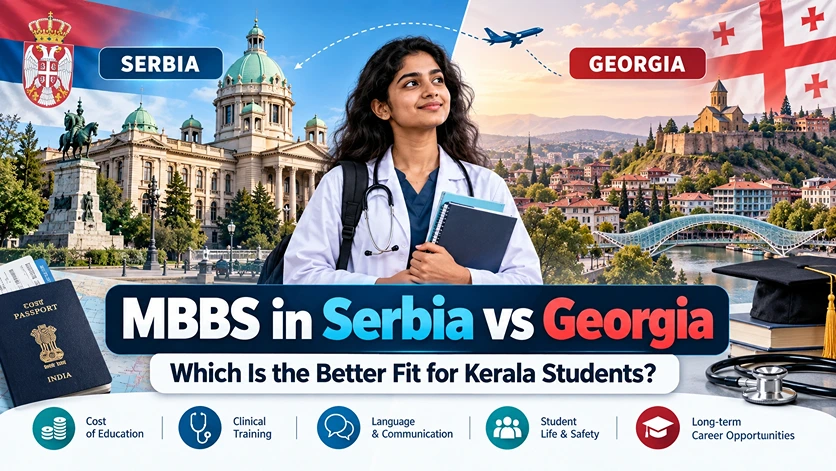
or the university with the biggest Indian student community.
For Kerala students and parents, the better choice depends on the exact medical programme, clinical training, internship structure, local-language requirements, total family budget, food, accommodation, winter adjustment, travel home and long-term plans after graduation.
A university that looks cheaper on paper may not remain cheaper after rent, flights, insurance and daily expenses are included. Similarly, an English-medium medical programme does not mean every patient interaction during clinical training will happen in English.
The most useful approach is therefore simple:
Compare universities and programmes first. Compare countries second.
That matters whether your family is in Kochi, Kozhikode, Malappuram, Thrissur, Kannur, Kottayam or Thiruvananthapuram. Medical study abroad is a multi-year academic and financial commitment, and parents should evaluate the full picture before paying an admission deposit.
Serbia vs Georgia Comparison Table
| Factor | Serbia | Georgia | What Kerala Students Should Check |
|---|---|---|---|
| English-medium medicine | Available at selected universities | Available at selected universities | Confirm the exact programme and teaching language in writing. |
| Programme examples | Niš and Novi Sad currently list six-year medical programmes. | Ilia State University and the University of Georgia list six-year, 360-ECTS programmes. | Check the current curriculum, duration and clinical structure. |
| Sample tuition | Niš: €6,000/year; Novi Sad: €7,000/year for 2026/27. | TSMU currently lists US$8,000/year for its English-medium MD programme. | Never treat one university's fee as the national average. |
| Local language | Relevant to investigate for clinical patient contact. | Relevant to investigate for clinical patient contact. | Ask when local-language teaching starts and how it is used in hospitals. |
| Clinical training | University and hospital specific. | University and hospital specific. | Request hospital names, rotation details and internship information. |
| Living expenses | Depend on city, accommodation and lifestyle. | Depend on city, accommodation and lifestyle. | Build a realistic annual family budget instead of relying on a quoted package. |
| Weather | Considerably colder than Kerala in winter. | Considerably colder than Kerala in many locations. | Budget for winter clothing, heating and adjustment. |
| Travel from Kerala | Route and cost depend on travel dates and city. | Route and cost depend on travel dates and city. | Compare total journey time, stops, baggage and onward travel. |
| Immigration | Indian ordinary-passport holders currently require a visa for Serbia. | Georgia provides a study residence-permit route for eligible foreign students. | Check the latest rules before admission and travel. |
| Indian registration | Depends on the specific foreign programme satisfying applicable Indian requirements. | Same. | Do not rely on the phrase “NMC-approved university”. |
Start With the University, Not the Country
Families often begin by asking:
“Is Serbia better than Georgia for MBBS?”
That question is too broad.
The experience at one medical university can differ substantially from another university in the same country. Course structure, hospital access, student support and local-language teaching may all vary.
A better shortlist process is:
- Identify the universities you are seriously considering.
- Obtain the official curriculum and admission information.
- Check the programme against current Indian regulatory requirements.
- Review clinical training and internship arrangements.
- Calculate the full family cost.
- Speak with current students at the same university.
- Then compare Serbia and Georgia as destinations.
Unpopular truth
A destination that is cheaper, more popular on social media or familiar to other Indian students is not automatically the better academic fit.
Popularity can make adjustment easier, but it cannot replace programme verification.
How Do Medical Programmes in Serbia and Georgia Compare?
Several universities in both countries offer medicine in English.
The University of Niš currently advertises Medicine in English for the 2026/27 academic year, while the University of Novi Sad describes its English Medicine programme as six years, 12 semesters and 360 ECTS.
In Georgia, Ilia State University states that its English-taught Medicine programme runs for six years and carries 360 ECTS. The University of Georgia also lists Medicine as an English-language, single-cycle programme carrying 360 ECTS.
For an Indian student, however, a six-year duration or an English-medium label should never be the end of the check.
Ask the university for:
- the complete curriculum;
- total programme duration;
- teaching language;
- clinical rotation schedule;
- teaching hospital names;
- internship or clerkship structure;
- location of all clinical training;
- the qualification awarded at graduation.
Keep copies of the documents you receive.
What Do Current NMC Rules Mean for Students Studying Abroad?
This is one of the most important parts of the decision.
The National Medical Commission currently lists the Foreign Medical Graduate Licentiate Regulations, 2021 among its applicable regulations. NMC’s published FAQ explains that, for students covered by those regulations, the foreign medical course must have a minimum duration of 54 months and the medium of instruction must be English.
NMC’s April 2026 alert also highlights programme duration, medium of instruction, syllabus and curriculum, clinical training, and internship or clerkship arrangements as areas students need to check carefully. The alert summarises requirements including at least 54 months of medical education in a single institution and a 12-month internship at the same foreign university, along with restrictions on splitting clinical training across countries.
NMC also clearly states that it does not endorse a list of foreign medical institutions or universities. Instead, students are advised to obtain details such as fees, course content, duration and internship directly from the institution.
That is why phrases such as “NMC-approved university” should be treated cautiously.
The question is not whether a country or university carries a marketing label. The question is whether the specific programme and the student’s training pathway satisfy the regulations that apply to that student.
At the time of this update, NBEMS continues to conduct the Foreign Medical Graduate Examination (FMGE), including an October 2026 session. Students planning several years ahead should still check which registration and examination pathway is in force when they graduate.
Questions to ask before admission
Ask the university:
- Is the whole medical programme completed at this institution?
- Where does each clinical rotation take place?
- Where is the internship completed?
- Is any part of the course delivered in another country?
- What language is used for classroom teaching?
- What language is expected during patient interaction?
- What qualification is awarded?
- What documents prove the clinical and internship structure?
Keep the replies in writing.
Need Help Checking a Shortlisted University?
If you already have a university in Serbia or Georgia in mind, Help Abroad Consultancy can help you organise the curriculum, hospital, internship and admission documents that should be checked before you make a decision.
We do not certify official NMC eligibility. The aim is to help your family identify the right questions and documents for independent verification.
Serbia vs Georgia MBBS Cost: Look Beyond Tuition
When families compare Serbia vs Georgia MBBS cost, tuition is usually the first figure they see.
It should not be the last.
For 2026/27, the University of Niš currently lists Medicine in English at €6,000 per year, while the University of Novi Sad lists Medicine at €7,000 per year.
For students checking MBBS in Georgia fees, Tbilisi State Medical University currently lists its English-medium Medical Doctor programme at US$8,000 per year.
Do not use those figures to conclude that “Serbia costs X” or “Georgia costs Y.” Other universities may charge differently, and living costs vary by city and lifestyle.
A proper family budget should include:
- annual tuition;
- accommodation;
- food and groceries;
- utilities and heating;
- health insurance;
- local transport;
- residence or visa-related expenses;
- books and equipment;
- winter clothing;
- mobile and internet;
- flights to Kerala;
- airport transfers;
- emergency funds.
A family from Malappuram or Kannur may also use a different Kerala airport and route from a student based near Kochi or Kottayam. Calculate travel using the journey your family is actually likely to take.
Do this now: Build a six-year budget
For every shortlisted university:
- obtain the current official fee sheet;
- get three realistic accommodation examples;
- ask current students about monthly grocery spending;
- estimate two journeys home per year if that matches your family plan;
- include first-year setup expenses;
- add an emergency reserve.
Save the date and source for every figure.
How Important Is Local Language During Clinical Training?
Very important.
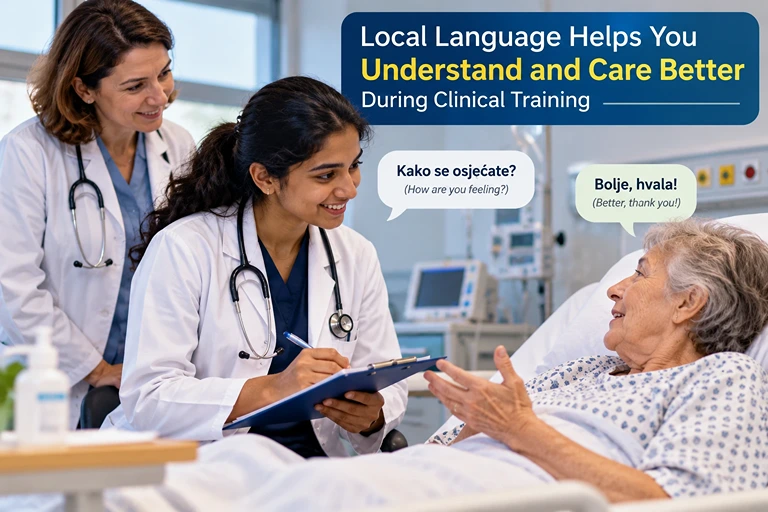
English-medium education tells you the language of instruction. It does not guarantee that patients in teaching hospitals will speak English.
During clinical years, medical students may need to:
- take patient histories;
- understand symptoms;
- give examination instructions;
- communicate basic information;
- interact with hospital staff.
This matters whether you are researching MBBS in Serbia for Indian students or MBBS in Georgia for Indian students.
Ask:
- Is the local language compulsory?
- For how many semesters?
- Is medical vocabulary taught?
- What level is expected before hospital postings?
- How much direct patient communication do international students receive?
Unpopular truth
Local-language classes are not simply an extra subject to pass.
For a medical student, language can affect how confidently and meaningfully they interact with real patients.
How Should Families Assess Clinical Exposure?
The phrase “good clinical exposure” is too vague to help a parent make a decision.
Ask for details.
Questions to ask the university
- Which hospitals are used for clinical training?
- When do hospital postings begin?
- Are those hospitals owned by or formally affiliated with the university?
- Are international and local students given similar clinical rotations?
- How large are clinical groups?
- Do students take histories from real patients?
- What language is used with patients?
- Where is the internship completed?
- Does any part of training happen outside the university or country?
NMC’s current guidance makes clinical-training and internship arrangements important parts of the foreign medical education check.
Parents should request written answers rather than relying only on a counselling call or a student’s social-media video.
Food, Accommodation and Daily Life for Kerala Students
Students often adjust better when they know what normal daily life will look like.
For many Kerala students, food is a practical concern rather than a minor comfort issue.
Before admission, ask current students about:
- availability of rice and familiar groceries;
- Indian spices;
- chicken, fish, eggs and vegetables;
- shared-kitchen facilities;
- supermarkets near accommodation;
- cost of eating outside;
- whether Indian or Kerala-style food is available nearby.
A student who can cook regularly may have more control over both food and monthly spending.
Accommodation questions
Do not ask only, “Is hostel available?”
Ask:
- Is it university accommodation or private housing?
- What is included in the rent?
- Are heating and electricity separate?
- How far is it from classes and hospitals?
- Is public transport available in the evening?
- Who helps if a student needs to change accommodation?
Speak to current Indian students at the same university, preferably students in different academic years.
Weather: A Bigger Adjustment Than Many Students Expect
Students moving from Kerala to Serbia or Georgia should plan for a substantially different winter experience.
This affects more than comfort.
Families may need to budget for:
- winter jackets;
- thermal clothing;
- waterproof footwear;
- heating;
- shorter winter daylight;
- commuting in colder conditions.
Students from Thiruvananthapuram or Kochi who have never lived through a cold winter may need time to adjust.
The practical question is not which country has “better weather.” It is whether the student is prepared for the location where the university is actually based.
Travel From Kerala
Travel convenience matters when a student may return home during semester breaks or emergencies.
For each shortlisted university, compare:
- departure airport in Kerala;
- number of flight connections;
- total journey time;
- baggage allowance;
- transit requirements;
- arrival airport;
- onward journey to the university city;
- fares during common holiday periods.
For Serbia, the Ministry of Foreign Affairs currently states that Indian ordinary-passport holders require a visa.
Georgia’s State Services Development Agency currently provides a study residence permit for eligible foreign students enrolled at authorised institutions and lists the supporting documentation required for the application.
Immigration rules can change, so check them again before admission and travel.
What About Safety and Student Support?
Avoid broad claims such as “Serbia is safer” or “Georgia is the safest destination.”
Safety depends on the city, neighbourhood, accommodation, transport and individual circumstances.
Parents should investigate:
- the exact accommodation area;
- late-evening transport;
- university security;
- emergency contacts;
- health insurance arrangements;
- international student support;
- access to medical care;
- Indian student networks;
- how students handle emergencies.
A strong Indian student community can help with settling in, but it should remain a support factor rather than the main reason to choose a medical programme.
Myth vs Fact
| Myth | Fact |
|---|---|
| “English-medium means students do not need the local language.” | Local language may still matter during patient communication and hospital training. |
| “NMC has an approved list of foreign universities.” | NMC says it does not endorse a list of foreign medical institutions or universities. |
| “Lower tuition means the degree will cost less overall.” | Accommodation, food, travel, utilities and other expenses affect the final family cost. |
| “A six-year course automatically makes a graduate eligible in India.” | The complete programme and training pathway must meet the applicable requirements. |
| “A university with many Indian students must be the better choice.” | Student community is useful, but academic, clinical and regulatory factors should come first. |
Field Note From Help Abroad Consultancy
At Help Abroad Consultancy, we often meet families who begin with one question:
“Which is better: Serbia or Georgia?”
We usually change the order of the discussion.
First, we look at the student’s university shortlist. Then we examine the curriculum, clinical arrangements, internship information, tuition, accommodation and practical family budget.
Only after that does the country comparison become useful.
We have also found that parents often notice different issues from students. Students may focus on campus life and friends, while parents may focus on costs, travel and future registration. Both viewpoints matter.
The goal is not to push every student towards the same destination. It is to help the family ask better questions before making a long-term commitment.
If your family already has two or three universities on the shortlist, bring those names to the discussion. Comparing real options is far more useful than comparing two countries in the abstract.
FAQs
There is no responsible country-wide answer based on tuition alone. For 2026/27, the University of Niš lists Medicine in English at €6,000 per year and the University of Novi Sad lists €7,000 per year, while Tbilisi State Medical University currently lists its English-medium MD programme at US$8,000 per year. Living costs and other expenses still need separate comparison.
Selected Serbian universities offer Medicine in English. The University of Novi Sad currently describes its English programme as six years and 360 ECTS, and the University of Niš also admits students to Medicine in English.
Yes, selected Georgian universities have English-medium medical programmes. Ilia State University currently lists a six-year, 360-ECTS English Medicine programme, and the University of Georgia also lists Medicine in English.
NMC states that it does not endorse a list of foreign medical institutions or universities for MBBS or equivalent courses. Students should evaluate the specific programme and obtain course, fee, duration and internship information directly from the institution.
A foreign medical degree by itself does not guarantee registration in India. Students must satisfy the regulatory and examination pathway applicable to them when seeking registration. NMC’s FMGL rules apply to covered students, while NBEMS continues to conduct FMGE in 2026.
Yes. Even when teaching is in English, patients and hospital staff may use the local language. Ask the university what language students learn, when patient contact starts and what level of communication is expected during clinical rotations.
There is no single answer to MBBS in Serbia vs Georgia that will suit every Kerala student.
Serbia may offer an attractive option at one university, while a particular Georgian programme may fit another student’s needs better. The reverse can also be true.
What matters is the complete programme.
Compare the curriculum, clinical training, internship, local language, full cost, accommodation, student support and travel. Then check the current Indian regulatory requirements independently.
For parents, this approach makes the decision more transparent. For students, it gives a clearer idea of what the next six years may actually involve.
The most useful principle to remember is:
Choose the university and programme on evidence—not the country on reputation alone.
Want to Compare Your MBBS Shortlist With Your Family?
Book a free 20-minute MBBS abroad counselling call with Help Abroad Consultancy.
The discussion can be in Malayalam or English, parents are welcome to join, and you can bring the names of the Serbian or Georgian universities you are currently considering.
We can help you organise the costs, university documents and questions that need further verification before you make a decision.
Discuss My MBBS Shortlist →