
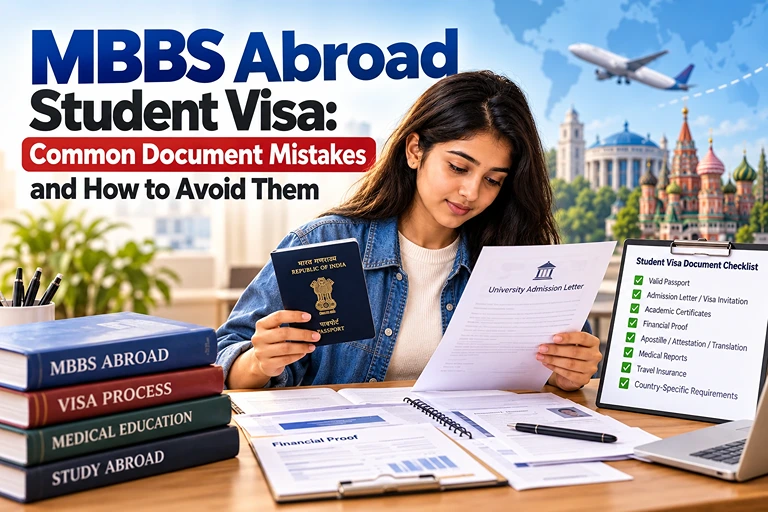
Receiving an admission offer from a foreign medical university is an exciting moment. However, completing the MBBS abroad student visa process requires careful attention to documents, deadlines, and immigration rules.
A minor spelling difference, an incorrect invitation letter, or incomplete financial evidence can create problems even when university admission is confirmed.
For Indian students planning to study medicine in Georgia, Russia, Kazakhstan, or other destinations, understanding these mistakes early can prevent unnecessary complications.
This guide explains the most common MBBS student visa documentation errors, the differences between country requirements, and the steps students can take to prepare a stronger application.
Early document checks reduce avoidable corrections, but a complete application never guarantees visa approval.
Why MBBS Abroad Visa Documentation Needs Special Attention
The paperwork required for medical education abroad comes from different authorities.
The university checks admission eligibility. Immigration authorities check whether the student qualifies for the required visa. Indian medical regulators separately determine the conditions for future medical registration in India.
A student may therefore have valid admission documents but still lack the evidence required for a visa.
For example, an ordinary admission letter may be sufficient to establish the purpose of study for one destination but may not replace the government-issued invitation needed for another.
Students must also understand that visa approval does not establish whether their foreign medical programme satisfies India’s National Medical Commission (NMC) requirements.
Before paying substantial university fees, review the NMC’s official guidance on foreign medical education.
University admission, immigration permission, and future Indian medical-registration eligibility are three different checks.
Nine Common MBBS Abroad Student Visa Document Mistaakes
Most preventable documentation problems can be identified by checking identity details, official supporting records, and document validity.
1. Passport and Academic Certificate Name Mismatches
Indian students sometimes have initials on Class 10 or 12 certificates but expanded names on their passports.
A university may issue an admission letter using one version, while the visa application uses another.
How to avoid it: Compare your passport, academic records, application form, and admission letter before requesting final visa documents.
If the names differ, ask the issuing authority and relevant consulate whether an official correction or supporting document is required. Do not assume an affidavit will always be accepted.
2. Confusing the Admission Letter With a Visa Invitation
An admission offer confirms that a university has offered a place. It does not always serve as the official document needed for a student visa.
Russia generally requires an invitation issued through its competent immigration authority. Kazakhstan’s published C9 study visa guidance also specifies approved visa support and a university letter.
How to avoid it: Ask the university whether a separate visa invitation is required and verify its details before submitting the application.
3. Ignoring Passport Validity Rules
Different countries have different passport validity requirements.
Russian official guidance specifies an extended validity period for study visa applications. Georgia and Kazakhstan apply their own rules.
How to avoid it: Check the relevant consulate’s requirements for passport expiry, condition, and blank pages. Do not rely on the general assumption that six months of validity is enough everywhere.
4. Incorrect Apostille, Attestation, or Translation
Students often confuse three different processes:
- Apostille: Authentication of certain public documents under the Hague Apostille Convention.
- Legalisation: A process used to authenticate documents for recognition by foreign authorities.
- Certified translation: A translation prepared or certified according to the receiving authority’s requirements.
Getting an unnecessary apostille or using an unacceptable translation can waste money and cause additional work.
How to avoid it: Confirm the destination’s document authentication rules before beginning the process.
Kerala students can also consult NORKA Roots certificate attestation information where relevant.
5. Incomplete Financial and Sponsorship Documents
Some countries require proof that a student can meet tuition and living expenses.
An application may become problematic if the bank statement covers the wrong period, the sponsor’s relationship is unclear, or supporting documents are missing.
How to avoid it: Check the exact financial evidence required. If parents are sponsoring the student, prepare the relevant sponsorship and relationship documents when requested.
Never use fabricated bank statements or misleading financial information.
6. Missing Medical Certificates or Insurance
Health-document rules differ across destinations.
Russian study visa guidance includes an HIV test certificate. Georgian immigration visa requirements include travel and health insurance.
How to avoid it: Confirm which tests and insurance documents are needed, whether approved providers must be used, and how long the documents remain valid.
Preparing a time-sensitive test too early can be as unhelpful as preparing it too late.
7. Applying Under the Wrong Visa Category
Tourist visas and long-term study visas are not automatically interchangeable.
For instance, Georgia uses the D3 immigration visa category for qualifying long-term study.
How to avoid it: Verify the correct category through the destination’s official immigration or consular website before submitting the application.
8. Missing Accommodation or Parental Consent Evidence
A student may have a valid admission letter but lack proof of where they will stay.
In Georgia, proof of accommodation is included in the published immigration visa requirements. Applicants under 18 may also need written consent from a legal representative.
How to avoid it: Check whether hostel confirmation, rental evidence, parental consent, or related supporting documents are necessary for your application.
9. Submitting Documents Without a Final Review
A visa application can contain accurate documents that nevertheless contradict one another.
For example, the admission letter may mention one passport number while the application uses a renewed passport.
How to avoid it: Conduct a final cross-document audit instead of simply counting the documents in the folder.
The next section explains how.
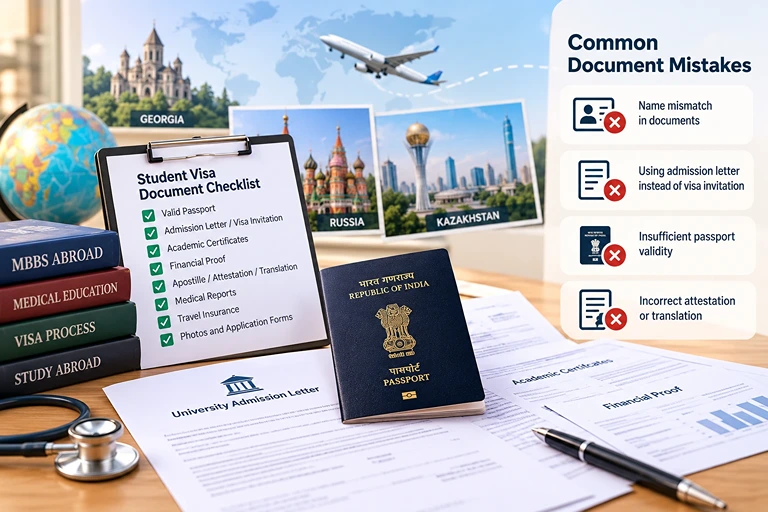
Country-Specific Visa Requirements: Georgia, Russia and Kazakhstan
Never reuse another country’s student visa checklist without verifying the requirements of the destination authority.
These three destinations illustrate why a universal MBBS visa checklist is unreliable.
| Country | Study Visa Route | Important Documentation | Official Timing or Validity Example |
|---|---|---|---|
| Georgia | D3 Immigration Visa | Admission evidence, financial proof, accommodation and insurance | Published decision period: 30 calendar days |
| Russia | Ordinary Study Visa | Official invitation and applicable medical records | HIV certificate validity: 3 months |
| Kazakhstan | C9 Study Visa | Approved visa-support invitation and university letter | Older India-specific guidance lists a 5-working-day processing period |
Georgia: Check More Than Your Admission Letter
The official Georgia study visa guidance lists evidence concerning the purpose of study, finances, accommodation, and health insurance.
A student who concentrates only on university admission could overlook these supporting requirements.
Russia: Verify the Official Invitation
Russian study visa requirements place particular importance on the official invitation and applicable medical documentation.
Students can use Russian consular study visa guidance as a reference, but must follow the instructions of the Russian mission responsible for their application in India.
Kazakhstan: Admission and Visa Support Are Separate
The Embassy of Kazakhstan’s study visa information identifies both a university letter and approved visa support.
This is an important difference for students who assume one admission document will satisfy every requirement.
What Should Students Do If a Document Contains an Error?
Correct the source document through the responsible authority rather than repeatedly uploading an inconsistent copy.
Students often notice mistakes after receiving admission confirmation. What matters is identifying who can correct the error.
The three-step correction method
Step 1: Identify the source
Is the error in the passport, academic certificate, university letter, or visa form?
Step 2: Contact the correct authority
A passport error may need passport-authority action. A university letter error normally requires the university to issue a correction. A submitted visa application error must be handled through the relevant consulate or application system.
Step 3: Check every linked document
After correcting one record, confirm that the remaining records still agree.
For example, if your passport number changes after renewal, check whether the university must update its invitation letter.
Important: If an application has already been submitted, ask the visa authority whether amendments are permitted. Do not assume you can simply replace a document without informing it.
The Four-Point Visa Document Consistency Test
Four connected checks help students catch contradictions that a simple document checklist may miss.
Before submitting an MBBS abroad visa application, use this practical review framework.
| Check | What Must Agree? | Action if Incorrect |
|---|---|---|
| Identity | Full name, birth date and passport details | Verify with the issuing authority |
| Admission | Student identity, university, programme and study details | Request university clarification |
| Visa Purpose | Study category, invitation, application and intended travel | Follow official consular instructions |
| Supporting Evidence | Financial records, sponsorship, accommodation and insurance | Correct or supply required evidence |
Unlike a basic checklist, this method tests whether the documents tell a consistent story.
For example, a complete bank statement does not solve an unclear sponsorship arrangement. Similarly, an authentic invitation containing an incorrect passport number may still require correction.
This consistency check should be completed before final submission, even when an education adviser has already reviewed the file.
Common Red Flags That Students and Parents Should Notice
Guaranteed approval promises and requests for false documentation are serious warning signs.
Be cautious if anyone claims that:
- A university admission letter guarantees visa approval.
- A tourist visa can always be used for full-time medical education.
- A document mismatch can be ignored without confirmation.
- Financial records can be modified to meet embassy requirements.
- Every country has the same visa rules.
Myth vs Fact
Myth: More supporting documents always improve a visa application.
Fact: The correct documents matter more than the number submitted. Extra documents cannot replace mandatory evidence.
Myth: Applying at the last minute is safe if admission is confirmed.
Fact: Invitation processing, document correction, and consular decisions may require additional time.
Kerala Student Field Note: Catching an Error Before Submission
The final visa review should involve the student, not only parents, universities, or intermediaries.
Consider a student from Thrissur who receives an admission letter for a medical university in Russia.
The student’s passport has recently been renewed, but the university issued its invitation using the previous passport number.
The family has every required document and initially assumes the file is complete.
A final comparison reveals the difference.
Rather than submitting the application immediately, the student contacts the university and the responsible consular office to establish the correct procedure.
The lesson is that document completeness and document consistency are not the same thing.
For parents seeking a broader document preparation schedule, the website’s existing MBBS abroad passport-to-apostille timeline provides a useful companion guide.
MBBS Abroad Student Visa Final Checklist
Students should finish separate pre-submission and post-approval checks to protect their travel and admission plans.
Checklist 1: Before Visa Submission
- Confirm the correct visa category.
- Compare passport and academic identity details.
- Verify the admission letter and official invitation.
- Confirm apostille, legalisation, and translation requirements.
- Check financial and sponsorship records.
- Confirm medical documents, insurance, and accommodation evidence.
- Verify current deadlines and application instructions.
Proof to keep: Official checklist, dated document copies, written university clarifications, and submission receipt.
Checklist 2: After Visa Approval
- Verify your name and passport number on the visa.
- Check visa category, entry dates, and expiry.
- Confirm university reporting instructions.
- Check arrival registration or residence permit requirements.
- Carry the documents required for immigration and enrolment.
- Keep secure digital copies of important records.
Proof to keep: Visa copy, university instructions, travel records, and relevant receipts.
Frequently Asked Questions About MBBS Abroad Student Visas
Most applications involve a valid passport, visa form, and evidence of admission or study purpose. Additional requirements may include an invitation, photographs, financial records, insurance, medical certificates, or accommodation evidence. Check the exact destination-specific list.
Yes. Differences between the passport, academic certificates, and admission records may require clarification or correction. Contact the appropriate authority before submission rather than assuming the difference will be accepted.
Indian and OCI candidates intending to obtain a foreign undergraduate medical qualification are subject to applicable NMC NEET eligibility rules. NEET requirements should be checked separately from the destination’s visa conditions.
No. The need for an apostille depends on the document and destination. Some applications may require another form of authentication or a certified translation. The Indian Ministry of External Affairs apostille guidance explains the Indian authentication framework.
Yes, insufficient or unacceptable financial evidence can affect applications where proof of funds is required. Students should submit genuine records in the format requested by the visa authority.
Review the official refusal notice and determine whether correction, a new application, review, or appeal is allowed. Address the stated issue rather than resubmitting the same documents without changes.
Begin checking permanent records such as passports and academic certificates early. Prepare time-sensitive medical, banking, and insurance documents according to the destination’s published requirements and your intended application date.
An MBBS abroad student visa application is not simply a collection of forms and certificates. Every document should accurately support the student’s identity, admission, financial arrangements, and purpose of travel.
The most useful preparation is to identify inconsistencies before they reach the visa authority.
Students should always follow official country-specific instructions, confirm unclear requirements in writing, and review their completed application independently.
For those planning medical education abroad, careful documentation is an important step towards beginning their studies with fewer avoidable complications.
Planning to Study MBBS Abroad? Get the Right Guidance!
Don't let document mistakes delay your medical education journey. Help Abroad can help you understand MBBS admission requirements, prepare your documents, and plan your next steps with confidence.
Get Expert Guidance for MBBS Abroad →